


On this page we will try to provide the ultimate guide to custom foot orthotics with all of the information that you need to know to make an informed decision regarding custom orthotics. Whether you are considering getting orthotics from us or elsewhere, we recommend you read this page and it’s links before you make an appointment to have custom orthotics made for you. Among other things, we will answer these questions:
- Are foot orthotics right for you?
- Who should make them?
- What is the best way to cast the foot?
- What conditions can orthotics treat?
Leaders in Effective Treatment Using Orthotics
The Foot & Ankle Center of Washington is the premier center for foot orthotic therapy in the Seattle area and Northwest United States. Our podiatrists’ unique credentials make them some of the nation’s most skilled at custom-designing these devices to precisely control function and resolve your problem. We specialize in custom foot orthotics, biomechanical and gait evaluation and have become the primary referral center for orthotic therapy in the greater Seattle area.
Why We are Your Best Choice for Custom Orthotics
You have many choices of where to get custom orthotics. When you choose the Foot and Ankle Center you will likely achieve much better relief of symptoms and more comfortable orthotics than at other clinics. Read more to learn why your orthotics will work better if made by Dr. Huppin or Dr. Hale.
For an evaluation, contact us today for an appointment in our convenient Seattle foot and ankle clinic.
We have a number of patients who travel to see us particularly for orthotic therapy. If you will be coming to see us from a distance, please let our receptionist know so that we can schedule appropriate time.
Video: Orthotics for Heel Pain – Why Your Doctor Must Understand Orthotic Research to Make the Best Orthotics
What are Orthotics?
The term “orthotic” can refer to almost any device which is worn inside a shoe. Items called “orthotics” can be found in infomercials, retail stores and even at trade shows. There are three very different types of “orthotics” – custom, customized and off-the-shelf. The educated consumer should be aware of each type.
There is a confusing amount of information available on orthotics. For many consumers making an informed decision is difficult. Recognizing a sales pitch and separating it from facts is the key to better health. The information in this section should provide the information you need to make an informed decision.
What are Custom Orthotics?
Custom foot orthotics are prescription medical devices made from non-weight bearing molds or scans of your feet. They are designed to control alignment and function of the foot in order to treat or prevent injury-causing motions such as pronation (rolling-in) and supination (rolling-out). They also act to make activities such as running, walking – even standing – more efficient. Finally, they can act to redistribute pressure on the bottom of the foot to relieve pain from excessive pressure or calluses.
How do Custom Foot Orthotics work?
Most foot pain is the result of a faulty relationship between the bones and muscles of the foot. Even the slightest misalignment can result in significant discomfort. This abnormal function can result in problems such as bunions, hammer toes, arch and heel pain, corns, knee pain … even back pain.
The function of custom orthotics is much more than an arch support. Orthotics realign the structures of the foot and leg to prevent bone mal-alignment as well as muscle, tendon, and ligament fatigue. They are often used after surgery to help stop the recurrence of foot deformities.
As your foot rests on the orthotic it is gently and consistently directed into the correct position for walking, running, and standing.
Because your foot is now functioning properly, the pain of muscle strain and pressure points is relieved, and the progression of deformities is stopped or slowed.
Production of Custom Orthotics
Proper production of custom orthotics is an exacting process and determines whether or not you receive quality devices that will best treat your condition. As with everything, there are well-made orthotics and poorly-made orthotics. The ability of an orthotic device to eliminate your pain is dependent on the quality of the orthotics.
The quality of the orthotics is dependent on three primary steps:
1. The cast of your feet
2. The prescription the doctor writes (based on the examination and the doctors knowledge and experience
3. The work of the orthotic lab in producing your orthotics.
How Should Your Foot Be Casted for Custom Orthotics?
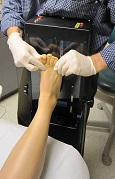
Laser Scan for Orthotics
There are several methods that can be used to obtain an image of the foot to make custom foot orthotics. The reality is that some work much better than others.
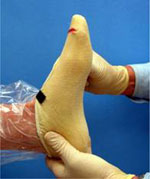
Fiberglass Cast
Unfortunately not all practitioners use the methods that have been shown to be most effective. This may be because they are not familiar with the literature, because they want a cheaper way to take the image of the foot, or because they were sold a “pressure mat” system that looks impressive but does not work particularly well. The most important criteria is the experience and skill of the medical practitioner, but regardless, there are some techniques that have been shown to be much more effective than others.
The only method that has been shown in the medical literature to be effective in producing a quality functional custom foot orthotics is a three-dimensional non-weight-bearing laser scan or cast of the foot. In this technique the foot is held in a precise position – essentially the position in which it should function. The image of the foot can be taken using a laser scan, plaster or fiberglass. All of these techniques can provide the same quality image as long as the foot is held in the correct position while the image is taken.
Who Should Take the Cast?
Casting position is absolutely critical to orthotic outcome. Thus, it is our opinion that only the doctor, and not a staff member, should take thescan or cast of your foot. Before making an appointment to have orthotics made, the first question you should ask is “who will take the cast of my foot – the doctor or an assistant?” If the answer is anyone other than the doctor, go somewhere else.
Video: Orthotics for Flat Feet: Why Do So Many Flat Foot Orthotics Fail?
Are There Other Methods to Take a Cast of the Foot for Orthotics?
There are 3 other methods used for making custom orthotics, but they have been shown to be ineffective for making orthotics that improve function of the foot (although they can be used to make simple arch supports). The three techniques are:
- Plaster or foam box casting where the patient sits and the foot is placed down on the floor to produce the cast.
- Walking across a force plate
- Standing on a digital imager of the foot.
Several studies have shown all of these methods to be less effective at producing well-functioning orthotics.
A 1989 Northern Arizona University study showed that having any weight on the foot during the casting or imaging process resulted in an orthotic shape that has been shown to cause pain in the big toe joint and tension on the plantar fascia.1, 2
A 2002 study from the Joiner Center for Sports Medicine at the University of Delaware showed that weight-bearing casting resulted in abnormal force under the big toe joint.3 This has been shown to result in the production of an orthotic that does not work well at reducing the forces that lead to common foot problems such as bunions, big toe joint pain, heel pain, arch pain, plantar fasciitis and other conditions.1 Non-weightbearing casting was recommended as the most reliable and valid method for making custom foot orthotics.3 .
Summary of Information about Casting for Custom Foot Orthotics
- Only a non-weightbearing laser scan or cast should be used (see figures above)
- Weight-bearing casts and images of the foot have been shown in the medical literature to be ineffective methods for producing functional foot orthotics.
- Whether you are sitting or standing does not matter. If your foot is on the floor during the casting process, you are not likely to get an orthotic that provides optimum function.
- The medical literature indicates that walking across a pressure mat cannot provide enough information to make a quality functional orthotic. The doctor, and not an assistant, should take the cast of your foot.
References on Orthotic Casting
- Forefoot to Rearfoot Angle – A Comparison of Orthotic Casting Techniques. McPoil, TG; Schmit, D. Phys Ther. 1989 Jun;69(6):448-52
- Position of the First ray and Motion of the First MTP. Roukis, et. al 1996 JAPMA. Vol. 86:11
- A comparison of four methods of obtaining a negative impression of the foot. McClay-Davis I, Laughton C, Williams, DS. J Am Podiatr Med Assoc. 2002 May;92(5):261-8
The Problem with “Computer Generated” Orthotics
If you (or your insurance company) is going to spend money on custom orthotics, make sure you are getting what you are paying for.
Unfortunately, there are a number of items being marketed as custom orthotics that really are not. These are often the product of a computerized system where the patient is asked to walk across a force plate which then shows pressure distribution on a computer display. Typically, the orthotic is made by adding extra components to a pre-manufactured insole. Sadly, patients are often told that these are custom – and charged a custom orthotic price.
Several studies have shown definitively that it is not possible to make an effective custom orthotic from pressure measurements. This “computerized orthotic” scheme has been around for a number of years. It looks very high tech, but the orthotic you get is no better, and many times worse, than a $35 prefabricated arch support.
You can see our favorite OTC supports here. These computerized gait analysis and orthotic systems are usually sold to practitioners with little training in foot orthotic therapy.
So how can you tell the difference between these semi-custom orthotics and authentic custom foot orthotics? If you are receiving authentic custom orthotic devices, a three-dimensional mold of your foot must be made. Your foot must be held non-weightbearing and your doctor can take this cast in three ways:
- Plaster
- Fiberglass
- Laser Scan
Walking or standing on a force plate can be used to evaluate some aspects of foot function, but a force plate cannot capture the 3-dimensional impressions of your feet that are necessary for best outcomes when prescribing orthotics. Remember, a non-weightbearing cast or scan of your foot must be taken in order to manufacture a functional custom orthotic.
If a practitioner suggests these “computerized orthotics” to you, go somewhere else or buy an inexpensive high-quality prefabricated orthotic instead.
References on Computer Generated Orthotics
- Forefoot to Rearfoot Angle – A Comparison of Orthotic Casting Techniques. McPoil, TG; Schmit, D. Phys Ther. 1989 Jun;69(6):448-52
- Position of the First ray and Motion of the First MTP. Roukis, et. al 1996 JAPMA. Vol. 86:11
- A comparison of four methods of obtaining a negative impression of the foot. McClay-Davis I, Laughton C, Williams, DS. J Am Podiatr Med Assoc. 2002 May;92(5):261-8
Orthotic Advertising on Radio, TV and Web – Buyer Beware
You may have heard radio or television commercials promoting “custom fit” orthotics at shoe and orthotic retail stores. While these devices are not “bad” per se, they are substantially over-priced. Our advice is “let the buyer beware” – you should never pay more than $70.00 for an “orthotic” unless it is made from a cast of your foot by an experienced and skilled medical professional.
You may have also seen web sites selling “custom” orthotics based on a foam box of your feet. While a foam box can be used to take a cast of the foot for custom orthotics (although it is not a particularly effective method), an extensive exam by an experienced and skilled medical practitioner is necessary to write the proper prescription for orthotics—and thus for optimum clinical outcomes. This isn’t to say you won’t improve with these devices, but the odds of maximum improvement are poor.
Again, just don’t spend more than $70.00 unless a thorough examination and casting by an experienced medical professional is taking place.
