




Achilles Tendon Pain Should be Treated at the Earliest Possible Moment
Left untreated, the Achilles tendon can become thickened and scarred (a condition called Achilles tendonosis) and very difficult to treat.
Although we do provides some hints on home treatment for Achilles tendon problems, these should only be used while you are waiting to see a specialist about your injury. Don’t try to treat Achilles tendonitis yourself – see a sports medicine foot and ankle specialist who has extensive experience in treating Achilles tendon injuries as soon as possible.
If you are in the Seattle area contact us for an appointment and we will get you in as early as possible.
Video: How to Treat Achilles Tendonitis and Tendonosis
What is the Achilles Tendon?
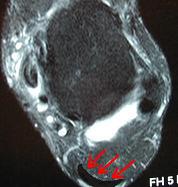
Figure 1: Normal Achilles – Tendon dark in color and crescent shaped.
The Achilles tendon is the strongest and largest tendon in the body. It is a tendinous structure (attaches muscle to bone) that forms from a combination of the gastrocnemius and soleus muscles located in the calf.
The tendon attaches to the heel bone (calcaneus) and causes the foot to push off (plantar flex) when the calf muscles tighten. The tendon is necessary for normal walking, running, and jumping. Athletic and traumatic injuries to the Achilles tendon are common and can be disabling.
What is Achilles Tendonitis and Tendonopathy?
Tendinitis is inflammation of a tendon. Thus, Achilles tendinitis is an inflammation of the Achilles tendon. The inflammation may be localized to the end of the tendon closest to the heel or may spread upward to affect even the muscles of the calf. Swelling often occurs and pain is felt upon contraction of the calf muscles. In severe cases, pain may be felt even at rest.
Achilles tendonopathy is a more general term that simply means damage to the tendon.
Generally, Achilles tendonopathy begins as a dull pain at the back of the lower leg just above the heel when pushing off the ground with the foot. Unless the activity is stopped, the condition rapidly gets worse until any activity requiring a push-off from the ground by the foot becomes quite painful and nearly impossible. If it is left untreated, it can develop into one of two more serious conditions — Achilles Tendinosis and Achilles Insertional Tendonopathy.
These are degenerative change in the tendon and are very resistant to treatment. A normal Achilles tendon in solid in color and crescent shaped, Figure 1. Abnormal changes inside Achilles tendon called Achilles tendinosis (Figure 2). On this MRI, the abnormal tendon usually shows as thick and not solid black in color. Will usually see white speckles in the tendon.
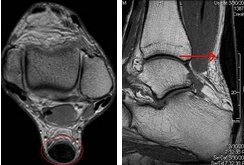
Figure 2: Achilles Tendinosis – Thickening of the Achilles tendon. Tendon round and thick.
How does the injury occur?
The majority of Achilles tendon injuries are due to overuse injuries. Other factors that lead to Achilles tendonitis are improper shoe selection, inadequate stretching prior to engaging in athletics, a short Achilles tendon, direct trauma (injury) to the tendon, training errors and heel bone deformity.
There is significant evidence that people with feet that role in excessively (over-pronate) are at greater risk for developing Achilles tendinitis. The increased pronation puts additional stress on the tendon, therefore, placing it at greater risk for injury.
What Part of the Achilles Tendon is Injured?
There are two basic locations where the Achilles tendon becomes injured – and they are treated differently. These are:
- Mid-portion Achilles Tendonopathy: This is any damage to the tendon (other than a rupture) that occurs in the tendon above where it attaches into the heel bone.
- Insertional Achilles Tendonopathy: This is damage to the tendon where it attaches into the heel bone.
What is the Most Effective Treatment for Achilles Tendonopathy
The latest studies on Achilles tendonopathies (including tendonitis) recommend a treatment plan that incorporates the following four components:
- Strengthening the Achilles tendon using eccentric exercise. These are a very specific type of exercise that has been shown in multiple studies to be a critical component of recovering from Achilles tendonopathy affecting the mid-portion of the Achilles.
- Shockwave therapy to stimulate healing of the tendon. Effective for both mid-portion and insertional Achilles tendonopathy and there is evidence that it is the best treatment for insertional.
- Reducing tension on the tendon through the use of heel lifts, orthotics and proper shoes.
- Reducing pressure on the tendon through shoe changes, shoe modifications, cushioning devices and / or temporary use of a walking boot.
Below we will examine each of these treatments:
Eccentric Exercise for Achilles Tendonitis
A number of well-respected papers over the past 15 years have stated that the best regime to cure an Achilles tendon problem involves eccentric loading (loading while the muscle and tendon are lengthening rather than shortening).3 Examples of eccentric exercises include standing on your toes on a step and lowering the heel, holding for a few seconds then coming up with the weight on the other leg.
This will slowly stimulate the tendon to heel over 2-3 months if repeated twice daily, but caution is needed at first to ensure that more damage is not caused. Sometimes the tendon is too weak to stand the strain and needs careful supervision. We will teach you proper technique so that the exercises are performed correctly and that injury is avoided.
Eccentric Loading Works Best for Mid-portion Achilles Tendon Problems
While eccentric exercise is a critical part of treating Achilles tendonopathy in the mid-portion of the Achilles tendon it has not been shown to be as effective for Achilles tendon pain when the pain is at the attachment on the heel bone. On the other hand, insertional achilles tendonopathy is simply harder to treat in general.
Video: How to do Eccentric Exercise for Achilles Tendonitis
Shockwave Therapy for Achilles Tendonopathy
Several studies have shown that the use of shockwave therapy can help stimulate healing and that those patients who receive shockwave therapy are more likely to recover and recover in a shorter period of time. 4,5
For example, a 2009 study showed that eccentric loading alone was less effective when compared with a combination of eccentric loading and repetitive low-energy shock–wave treatment.6
Achilles tendonoathy can be a difficult problem to treat. Given the numerous studies showing much improved outcomes with shockwave therapy, we recommend shockwave therapy as a primary treatment for Achilles tendonopathy (commonly called Achilles tendonitis).
Faster Recovery with Shockwave
Several studies have shown that patients who receive shockwave therapy for Achilles tendonitis showed improved recovery rates over other treatments. A 2011 study showed 78% improvement for mid-portion Achilles tendonosis and 84% for those with pain at the insertion (where the tendon attaches into the heel bone).4
Shockwave has been shown to be effective for Achilles pain in the tendon itself and at the Achilles tendon attachment on the heel bone. In fact there is Level 1 evidence (the highest level of medical evidence) showing:
- For mid-portion Achilles tendonopathy 56% of patients had complete recovery with eccentric exercise alone and 82% of subjects had complete recovery at 4 months with a combination of shockwave therapy and eccentric exercise10. More information on shockwave treatment of mid-portion Achilles tendon pain can be found in this article.
- For insertional Achilles tendonopathy 28% of patients had relief with eccentric exercise alone and 64% had complete relief in 4 months with a combination of shockwave therapy and eccentric exercise11.
Shockwave for Insertional Achilles Tendonoapthy
Pain where the Achilles attaches into the heel bone is often resistant to standard treatments, shockwave has been shown in multiple studies to be an effective and safe treatment that offers substantially improved outcomes.
A 2008 study compared eccentric loading to shockwave therapy for this problem. In this study, eccentric loading showed inferior results to low-energy shock wave therapy as applied in patients with chronic recalcitrant tendinopathy of the insertion of the Achilles tendon at four months of follow-up.8
In a 2016 study of using a combination of eccentric exercise and shockwave therapy, at the 12-month follow-up 65.0% of patients did not complain about pain, 27.5% patients got back to normal activities despite residual pain and 7.5% of the patients still complained about pain. There was no significant improvement in either score after eccentric exercises alone.9
In a 2008 study, after 4 months, 28% of patients had relief with eccentric exercise alone and 64% had relief with a combination of shockwave therapy and eccentric exercise11.
Video: Shockwave Therapy for Achilles Tendonopathy
Shockwave for Athletes
Many times athletes will choose shockwave therapy as a treatment method that is more likely to allow them to continue training.
At your visit we can help you decide if shock wave therapy is a good option to treat your Achilles tendon problem. Use this link to learn detailed information on the use of shockwave therapy.
You can find summaries of many articles pertaining to shockwave therapy for Achilles tendonopathy on this page.
Orthotics and Heel Lifts for Achilles Tendonitis – What the Research Tells Us
Foot Orthotics for Achilles Tendon Pain
The most important treatments for Achilles tendonopathies are eccentric strengthening and shockwave therapy. In addition, there is some evidence that orthotics may help reduce the forces that act to damage the tendon.
A 2014 study looked at the effect of using foot orthotics on the Achilles tendon. The researchers found that running with foot orthotics resulted in a significant decrease in Achilles tendon load compared to running without orthotics. This study indicates that foot orthoses may act to reduce the incidence of chronic Achilles tendon pathologies in runners by reducing stress on the Achilles tendon1. Orthotics seem to reduce load on the Achilles tendon by reducing excessive pronation2.
Other studies, however, show that there is minimal or no role for orthotics in treating Achilles tendonopathy.
Can Orthotics Help Treat Achilles Tendon Pain?
The right answer to this is that orthotics might play a role in helping SOME people with Achilles tendon pain.
Orthotics are not beneficial to everyone with Achilles tendon pain.
So which Achilles tendon pain patients benefit from orthotics?
Primarily people who have Achilles pain and who also have over-pronated (usually flatter) feet might benefit from orthotics. Other Achilles tendon pain patients are not as likely to benefit. Here is why:
The muscles that attach to the Achilles tendon is designed to do two things to the foot:
- Plantarflex the foot (point the toes downward)
- Invert the foot (help the foot roll invward)
If a foot is overly flat or pronated it is much harder to invert the foot and the Achilles must work much harder to make that happen. That extra work can damage the tendon.
Because the over-pronation puts such a great stress on the Achilles tendon, custom functional orthotics designed to control over-pronation are an important part of the treatment plan for this problem.
But if one has a foot type where the Achilles does not have to work very hard to invert the foot, then orthotics are not likely to make much difference in the treatment.
The key to proper treatment is to work with a practitioner who understands the mechanics of the Achilles tendon and how orthotics affect the tendon.
Prefabricated or Custom Orthotics for Achilles Tendonopathy?
Our philosophy is to do the least expensive treatment that provides 100% of the maximum achievable benefit. Some patients do great with a prefabricated orthotic. Others need a custom orthotic for best outcomes. There is, however, no harm in starting off with a prefabricated orthotic.
You can find our current list of recommended prefabricated orthotics for various foot types here.
Other Muscle Strengthening
A 2019 study showed that people with weak hamstrings may be at more risk for Achilles tendonopathy.
The reason for this is that those with weak hamstrings are more likely to over extend the knee. When the knee over-extends tension can increase in the Achilles and damage to the tendon can occur.
Heel Lifts for Achilles Tendon Pain
There is some evidence that heel lifts can help reduce tension on the Achilles which can help healing.
Heel lifts are particularly important for insertional Achilles tendonpathy as lifting the heel bone can decrease pressure between the heel bone and the Achilles tendon.
You can purchase an adjustable heel lift here.
Should Surgery Ever Be Considered for Treating Achilles Tendonitis?
According to the best studies we can find, a combination of eccentric strengthening and shockwave therapy will provide relief for about 75% of patients.
Failure of conservative treatment is more common in:
- older male patients
- those with longstanding symptoms
- those who persist in full training despite symptoms
- those who have uncorrected predisposing factors.
In these cases, surgery may be indicated. It should be remembered, however, that the rehabilitation program, particularly for severe Achilles tendon injuries, is a slow, lengthy program. Surgery is only indicated when there is failure to progress in the rehabilitation program. Surgery should not be considered unless at least six months of appropriate conservative management has failed to lead to improvement.
Can Stretching Help Achilles Tendonopathy?
There is no evidence that stretching is effective in reducing the symptoms of Achilles tendonopathy.
Self Treatment of Achilles Tendonitis?
If not treated correctly, Achilles tendonitis can lead to permanent damage to the tendon so we do recommend professional treatment of Achilles tendon injuries.
If you cannot see a doctor or must wait to see one, however, follow this 10-step Achilles Tendonitis Home Treatment Plan.
Achilles tendonitis only gets worse with time. If you are experiencing symptoms Contact us today for an evaluation in our Seattle clinic.
References
1 Effects of foot orthoses on Achilles tendon load in recreational runners J. Sinclair, J. Isherwood, P.J. Taylor. Clinical Biomechanics; August 2014.
2 Effect of combined heel lift and medial wedge orthoses on lower limb kinematics in chronic Achilles tendonitis patients. Harrison, AJ, Laxton, P and Bowden, PD 2001. Proceedings: International Conference on Biomechanics of the lower limb in health, disease and rehabilitation.
3 Heavy-load eccentric calf muscle training for the treatment of chronic Achilles tendinosis. Alfredson H, Pietila T, Jonsson P, Lorentzon R. Am J Sports Med 1998 May;26(3):360-366. Department of Orthopaedic Surgery, University Hospital of Northern Sweden, Umea, Sweden
4 Extra-corporeal pulsed-activated therapy (“EPAT” sound wave) for Achilles tendinopathy: a prospective study. Saxena, et al. J Foot Ankle Surg. 2011.
5 Efficacy and safety of extracorporeal shock wave therapy for orthopedic conditions: a systematic review on studies listed in the PEDro database. Schmitz, et al. Br Med Bull. 2015.
6 Eccentric loading versus eccentric loading plus shock–wave treatment for midportion achilles tendinopathy: a randomized controlled trial. Rompe, et al. Am J Sports Med. 2009.
7 The effectiveness of extracorporeal shock wave therapy on chronic achilles tendinopathy: a systematic review. Al-Abbad H. Foot Ankle Int. 2013. (Level 1 evidence)
8 Eccentric Loading Compared with Shock Wave Treatment for Chronic Insertional Achilles Tendinopathy: A Randomized, Controlled Trial Rompe, et al. The Journal of Bone and Joint Surgery (American). 2008
9 Low-Energy Extracorporeal Shock-Wave Therapy in the Treatment of Chronic Insertional Achilles Tendinopathy: A Case Series. Pavone, et al. BioMed Research International. 2016.
10 Rompe JD, et. Al Eccentric loading versus eccentric loading plus shock-wave treatment for midportion achilles tendinopathy: a randomized controlled trial. Am J Sports Med. 2009
11 Rompe JD.Eccentric loading compared with shock wave treatment for chronic insertional achillestendinopathy. A randomized, controlled trial.J Bone Joint Surg Am. 2008
Click Here For Self Treatment Hints
