




Shin Splints – Diagnosis, Treatment, Prevention
Shin splints usually do not clear up on their own, so make an appointment today to see us in our Seattle clinic so that we can get you back to full activity as soon as possible.
What Are Shin Splints?
 First “shin splints” are not an actual condition. Instead, it is a term used to describe a number of problems affecting the lower leg. Shin splints are an inflammation of the muscle attachments along the tibia (shin bone). They can be extremely painful and often resistant to treatment.
Shin splints may also be referred to as Medial Tibial Stress Syndrome (MTSS) or Tibial Fasciitis.
Two Types of Shin Splints
Dr. Hale and Dr. Huppin are experts at treating shin splints with a strict protocol based on the best evidence from medical literature.
There are two primary types of shin splints and they should be treated differently.
- Posterior shin splints are on the inside of the leg. This is the most common type and are officially known as medial tibial stress syndrome or tibial fasciitis.
- Anterior shin splints are on the front or outside of the leg.
Our treatment goal is to eliminate your pain as fast as possible and prevent the pain from returning. Most of our patients see improvement within a few weeks.
What Are the Symptoms of Shin Splints?
If you experience any of the following symptoms, you may need treatment for shin splints:
- Pain or tenderness along the inside of the shin, usually halfway down the shin.
- Pain and tenderness that extend from shin to knee.
- Pain on palpation of the shin.
- Severe pain at the start of a run that may disappear as the muscles loosen up during the run
Shin splints are different from a stress fracture, where there is pain during weight bearing activities such as walking or stair-climbing.
What Causes Shin Splints?
Posterior Shin Splints (Medial Tibial Stress Syndrome)
Posterior shin splints are also called medial tibial stress syndrome (MTSS) or tibial fasciitis. The primary cause is possibly excessive rolling in of the foot (over-pronation). This puts extreme stress on the muscles that run from the leg and into the foot. It is critical when treating this problem to decrease the stress on these muscles.
Not all researchers agree on the actual cause of MTSS. Some think it is due to a tightness of the Soleus muscle of the lower leg. Others think it is due to abnormal bending within the tibia bone. Regardless of the actual cause, researchers agree that (1) MTSS primarily affect runners and jumpers and doesn’t occur in people who only walk; and (2) MTSS patients usually have excessive pronation of the foot.
Anterior Shin Splints
Anterior shin splints have several causes and the best treatment will depend on the underlying cause. In most cases, we will analyze your gait to determine the underlying cause and provide a conservative treatment plan to get you pain free and back to full mobility.
Other causes of shin splints include:
- Overpronation (feet rotate too far inward on impact)
- Excessive running on hard surfaces such as concrete
- Inflexible calf muscles and tight Achilles tendons that place stress on the muscle attachments
- Incorrect or worn shoes
- Overtraining or a rapid increase in training load or intensity
Beginner runners are more susceptible to this problem for a variety of reasons, but most commonly due to the fact that the leg muscles have not been stressed in such a way before they started running.
Why Are Shin Splints More Common with Runners?
Shin splints from running are one of the most common conditions we treat in runners at the Foot and Ankle Center of Washington and we have had great success with conservative treatments. Essentially, shin splints from running are an over-use injury, caused by too much running before the legs are ready. This causes pain in the lower leg from overuse or chronic stress related fatigue syndromes.
The root cause of most shin splints is a chronic biomechanical imbalance of the lower leg and feet. That means you have bad feet, muscle imbalance, bad shoes, or improper training. It’s common with new runners that do too much, too soon, and too fast. New runners need more and better stretching as well as arch supports to prevent shin splints.
Can Stretching Help Shin Splints?
There is no evidence in the medical literature that a shin stretch helps treat MTSS, Stretching and exercises specifically designed to strengthen the muscles in the front of the leg, those over the shin, will be very helpful as well.
One of the most effective conservative treatments for shin splints, besides not running, is total contact orthotics therapy, with specialized orthotics for runners. You should also be very careful about the running shoes you buy. Do not skimp on quality. If you are unsure about the quality of the shoes in which you run, or if you fear they may be worn out, ask your podiatrist for a recommendation.
If you are a runner with MTSS, see a sports podiatrist right away.
What is the Treatment Plan for Shin Splints?
The goal of shin splint treatment is to reduce tension on the soleus muscle and reduce abnormal bending within the tibia. This usually requires a specialized custom orthotic. Once we control the abnormal forces with the correct shoes and orthotics, then we will start patients on a strengthening program.
The treatment plan will be designed to:
- Apply gentle compression to the involved muscles
- Decrease tension on the two muscles that contribute to shin splint pain with arch supports and stable shoes
- Increase strength of the lower leg
- Stimulate healing of the tissue (often with shockwave therapy)
- Decrease inflammation
- Prevent recurrence
When you come to see us at the Foot and Ankle Center for shin splint treatment, we will:
- Recommend specific shoes
- Recommend targeted strengthening exercises
- Recommend specific stretching exercises
- Prescribe physical therapy
- Prescribe custom or prefabricated orthotics
- Recommend shockwave therapy for medial tibial stress syndrome. There are currently no studies we can find that evaluate the effect of shockwave on anterior shin splints.
Orthotics for Medial Tibial Stress Syndrome
Orthotics for MTSS are some of the most specialized orthotics that we prescribe. The orthotics have to be made specifically to reduce tension on the muscle causing your pain.
Orthotics for Running Only
The orthotic modifications that are necessary to treat MTSS are very specific to running and to your specific gait and biomechanics. We will make you a specific orthotic to be used only in running shoes and prescribed specifically to reduce tension on the muscle causing the pain.
Gait Evaluation and Biomechanical Analysis for Medial Tibial Stress Syndrome
We usually will perform a slow motion running gait analysis and often will use a temporary orthotic before making you a custom orthotic. This temporary orthotic may need to be adjusted several times in order to determine the best orthotic prescription. Once we have determined the best prescription we can order your permanent custom orthotic.
Read more about why our orthotics work better. Custom orthotics are particularly effective for MTSS (posterior shin splints). If the injury does not improve, we may recommend additional diagnostics such as a bone scan, diagnostic ultrasound or X-ray may be necessary to check for a stress fracture.
Shockwave Therapy for Medial Shin Splints
If we don’t see rapid improvement in your symptoms by reducing stress on the tibia and the structures that attach to it and standard anti-inflammatory measures, then shockwave therapy is usually the next level of treatment.
Extracorporeal shockwave therapy is a safe and non-invasive therapy that has no potential complications or side effects. The goal of shockwave therapy is to stimulate healing of tissue – including the structures that attach to the tibia. Ideally 6 sessions of shockwave therapy are performed for the best outcome, each about 1 week apart. Treatments are usually not painful or cause only mild discomfort and take less than 15 minutes. The cost is $200 per session.
Shockwave therapy works by stimulating tissue healing in two ways:
- New Blood Vessel Formation: Shockwave therapy helps cause the formation of new blood vessels. This process, which is know as “neo-vascularisation” helps improve local blood flow so that nutrients that assist with tendon healing can reach the injured area.
- Release of growth factors: Growth factors are proteins that stimulate the cells that repair tissue. Several studies have shown that shockwave therapy is one of the more effective treatments for medial tibial stress syndrome.
In a 2017 study of 42 military cadets with medial tibial stress syndrome, those undergoing shockwave therapy had a mean running time without pain of about 18 minutes vs. only 4 minutes for those cadets who did not have shockwave therapy. 82.6% of patients had excellent or good results with shockwave vs. 36.8% in the exercise-only group. No significant adverse effects of shockwave were observed.1
In a 2009 study published in the American Journal of Sports Medicine, Forty-seven subjects with chronic recalcitrant MTSS underwent a standardized home training program, and received repetitive low-energy radial shockwave therapy.(treatment group). Forty-seven subjects with chronic recalcitrant MTSS were not treated with shockwave therapy, but underwent a standardized home training program only (control group). At 15 months from baseline, 40 of the 47 subjects in the treatment group had been able to return to their preferred sport at their preinjury level, as had 22 of the 47 control subjects. 2
Advantages of Shockwave for Medial Tibial Stress Syndrome:
- Acts to stimulate healing of the tendons and fascia that attach to the tibia.
- Studies on MTSS show that shockwave is an effective treatment for the problem about 80% of the time.
- An extremely safe treatment. There are no known risks or complications of shockwave therapy.
Disadvantages of Shockwave for Medial Tibial Stress Syndrome:
- Healing is slow. Shockwave acts to start a healing process in tissue that has stopped healing. This takes time. Maximum clinical benefits are found at 12 – 20 weeks with an average of 16 weeks to maximum benefit.
- Shockwave therapy is not covered by insurance. The cost is $200 per session. For medial tibial stress syndrome six sessions are recommended.
- Ideally, the first 3 sessions are done 3 weeks in a row. We then follow-up visits at 3 weeks and 6 weeks.
- If we are treating two feet at the same time (or two locations on one foot) the second location is $100 per session.
Are There any Home Remedies for Shin Splints?
If you want to try and treat your shin splints at home, we suggest you follow this plan rigorously for four weeks. Most of our patients see improvement in shin splint pain with this home treatment plan. If you don’t have improvement after two to four weeks, see a podiatrist who specializes in sports medicine.
#1 Use a compression sleeve
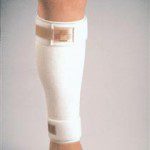 For the first two weeks, wear a Cho-Pat Shin Splint Compression Sleeve at all times. Then for the next two weeks, wear the Compression Sleeve for athletic activities. The sleeve works by applying gentle compression forces while firmly supporting the lower leg muscles and soft tissue. The sleeve also tends to stimulate circulation and maintain warmth which controls fluid build-up.
#2 Use a good arch support
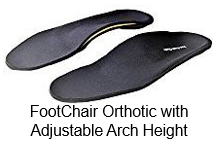 A good arch support will act to decrease painful joint motion by preventing arch collapse. An arch support with a higher arch and some rigidity will work best. These OTC arch supports will not work as well as a quality custom orthotic, but will help.
The best OTC arch support that we have found for shin splints is the FootChair Medical Grade Orthotic.
FootChair orthotics have a stable arch to start with plus they come with additional pads that can be added (up to two) to a pocket under the cover. This allows the arch to be increased for more support. For shin splints we recommend using both of the extra pads if they are comfortable.
#3 Wear slippers with an arch support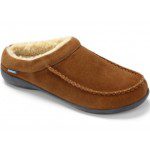
Around the house, use a slipper with arch support. We recommend Vionic Slippers or Vionic Sandals for their superior support and ability to reduce tension on the muscles of the shin.
During summer, avoid sandals or flip-flops that do not have arch support. We recommend Vionic Flip-flop Sandals 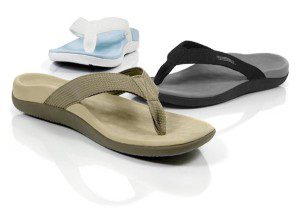 – our patients love them.
#4 Wear stable shoes
Always wear a stable shoe particularly during any weight-bearing activities. You can download our list of recommended shoes to find the best shoes for your feet.
#5 Pain relief measures
Use Biofreeze Orthogel Cold Therapy Roll-on as needed to reduce pain. Ice the painful areas for 10 minutes each evening.
What Should You do to Prepare for Your Appointment?
If you are a runner with shin splints, you should make an appointment to see us in our Seattle Foot and Ankle Center. While waiting for your appointment, begin the following shin splint home treatment:
- Stop running – If you have severe pain, stop running. If your pain is mild, reduce your training load and intensity, and avoid downhill running. For alternative workouts, check out our page on exercising with a foot injury.
- NSAIDs – Take a five to seven day course of non-steroidal anti-inflammatory drugs (ibuprofen or naproxen) if this is okay with your primary care doctor.
- Icing – Apply ice to the shin area for 10 minutes every two hours in order to reduce inflammation.
- Massage – Perform self-massage to only the muscle only – along the inside of the shin.
- Stretching – Stretch your gastrocnemius and soleus muscles in one leg, hold for 30 seconds then relax slowly. Repeat on opposite side. Repeat this stretch two to three times per day.
What Are the Best Flip Flops and Sandals for Shin Splints?
Wearing supportive flip flops and sandals can be helpful for reducing shin splint pain. Research shows when tension is reduced through the use of a supportive shoe, shin splints are decreased and recurrence is prevented. While it’s critical to wear proper shoes to keep leg and calf muscles healthy, orthotic flip flops are a good alternative if you want a more breathable, doctor-recommended shoe.
Vionic healthy flip flops and sandals come in options for men and women and are the best choice for shin splint patients. These are podiatrist-designed flip flops that combine fashion and pain relief into a practical shoe. All styles have built-in orthotics and are made with the highest quality materials, including patented footbed technology and biomechanical design.
Orthotic flip flops and sandals can reduce symptoms and pain associated with shin splints. A good arch support and proper running shoes also helps keep arches from collapsing and causing pain. This won’t prevent shin splints, but helps support the foot and reduce inflammation. Avoid poorly made sandals with no an arch support. For a complete list of the best flip flops and sandals for shin splints, click here.
Contact Us for a Shin Splint Consultation
At the Foot and Ankle Center of Washington, our doctors, Dr. Larry Huppin and Dr. Doug Hale, are nationally recognized experts in the use of custom made and personally fitted orthotics. They have helped hundreds of patients overcome a variety of running-related foot conditions. We regularly treat patients for shin splints, Achilles tendonitis, heel pain, arch pain, and stress fractures.
If you have leg pain during or after running, and you fear you may have developed shin splints from running, make an appointment today at the Foot & Ankle Center of Washington. Bring your running shoes with you for a comprehensive evaluation of your feet and running style, which will help us develop the most effective treatment plan. Call (206) 344-3808 or schedule online.
References
- Gomez Garcia S, et al. Shockwave treatment for medial tibial stress syndrome in military cadets: A single-blind randomized controlled trial. Int J Surg. 2017
- Rompe, et. al. Low-Energy Extracorporeal Shock Wave Therapy as a Treatment for Medial Tibial Stress Syndrome. Am. Jou. Sports Medicine, 2009.
