




Foot, Leg and Knee Injuries in Runners – How Orthotics Can Help
Foot, leg and knee injuries are the most common injuries that affect runners and joggers. For Seattle area runners with foot pain and biomechanical problems, Dr. Hale and Dr. Huppin provide the area’s greatest expertise in treating running-associated injuries. We help runners get back to full activity as soon as possible and prevent future problems. If you’re a runner and have an injury or want a biomechanical evaluation to help prevent running injuries, contact us today for an appointment in our Seattle clinic.
Video: What is the Best Running Shoe?
How Biomechanics Affect Your Running
It is easy to think of the feet as an area that may become overused and injured in runners. After all, it’s the first part of your body that hits the ground. And injuries to the feet or improper foot function can lead to problems elsewhere in the body. But when searching for factors that contribute to a running injury, a good starting point is the foot – even if it’s not just your foot that hurts. The biomechanics of your feet can play a huge role in whether or not you develop leg, knee, hip and back injuries.
Foot Types and Running Injuries
Running biomechanics are very complicated, but a simplified way to consider running mechanics is to look at foot types. Runners with high arches are referred to as supinators or under pronators. In their running gait, they may see decreased mobility and inadequate pronation during running. Runners with this foot type won’t absorb shock well. This shock is transmitted to lateral (outside) structures in the foot, lower leg, and knee. One common injury with high arch runners is anterior (lateral) shin splints.
Over pronators have the opposite problem. With this type of foot, there is too much motion resulting in excess pronation during running. These runners end up transmitting excess force to the medial (inside) structures of the leg. A common injury with over pronators is posterior (medial) shin splints. When you come into the Foot and Ankle Center for an evaluation, we study your gait and biomechanics to evaluate the underlying causes of your running pains and prescribe the best therapy.
Foot Orthotics Proven to Reduce Running Injuries
Recent studies into foot injuries common to runners or runners who experience an inordinate number of foot injuries, have shown that the use of foot orthotics will help them recover from foot injuries. Beyond this, the use of foot orthotics designed specifically for runners, have proven to be especially effective in preventing these injuries.
These customized shoe inserts may be prescribed to provide extra support and motion control for over pronators, or extra cushioning for under pronators. Orthotic quality varies widely between practitioners and in runners in particular it is critically important that orthoses be made in a very specific manner. We are known as experts in orthotics for runners. Click to read more on why our orthoses work better.
Studies on Foot Orthotics and Running Injuries
Several recent studies show that orthotics for runners can prevent injuries. Here’s a look at what those studies found.
• Study: “Orthoses in prevention of injury in military training” – The study looked at 400 officer trainees and half received orthotics and half did not. The orthotics group had 21 injuries after nearly 5,000 training hours while the non-orthotic group had nearly triple that with 61 injuries. Study authors concluded: “Orthoses were effective in the prevention of overuse lower limb injury. This is the first study to identify a positive preventive role of orthoses.”
• Study: “Orthoses and lower extremities during running” – The study examined 21 runners to discover risk factors for running injuries and how foot orthotics can reduce injury related complaints and/or prevent injuries. Study authors concluded: “The potential of foot orthotics for reducing pain and injuries is convincing.”
• Study: “Clinical effectiveness of customized sport shoe orthoses for overuse injuries in runners” – The study involved 99 patients with running injuries. Half were given custom orthotics and 58% saw a continuous decrease in pain and disability. Those without orthotics saw pain and disability increase by 23%. The authors concluded: “The results of our study justify the prescription of orthoses as a single-measure approach for runners who are still able to continue their training activity. The majority of participants responded well without any side treatments and reported high comfort wearing the orthoses.”
• Study: “Short- and long-term influences of a custom foot orthotic intervention on lower extremity dynamics” – This study looked at both short-term and long-term effects of foot orthotics on runners and found that after six weeks of using custom foot orthotics study participants reported a 73.1% decrease in symptoms and a significant decrease in pain.
• Study: “Evaluation of lower extremity overuse injury potential in runners” – This study found that those with a history of running-related injury had a significantly greater impact force when the foot hit the ground.
These studies clearly indicate that the stable base and enhanced support of an orthotic can improve underlying defects that can cause injuries and reduce foot stress. The use of custom orthotics specifically designed for running can reducing stress-related injuries common to runners including Achilles tendonitis and Runner’s Knee and help runners recover from injuries.
Which Runners Benefit from Orthotics?
Studies show that runners will benefit from the use of orthotics if:
- They do not currently have an injury
- They experience unusual fatigue in their legs
- They have a poor gait
- They have an over-use injury
Best Custom Orthotics for Runners
Many runners can prevent injury by the use of foot orthotics that are designed especially for the biomechanics of running. If you already have orthotics, your everyday orthotics can often be used in running shoes. Orthotics made especially for running, however, can often offer better protection against injury.
Based on recent studies of orthotics for runners, running orthotics should have the following features:
- Excellent arch contour to improve foot contact and spread force over a large surface area. These are called “total contact orthotics”
- A cover with extra cushion can decrease velocity of the foot as it strikes the ground resulting in decreased force throughout the lower extremity according to a 2008 study.
- Width of the orthotic equal to the width of the foot to ensure that the edge of the orthotic doesn’t irritate the bottom of the foot.
- Friction reducing cover to reduce blister potential.
- Shock absorbing heel post – the flat part of the orthotic under the heel.
Dr. Hale and Dr. Huppin are experts in prescribing orthotics for runners. Orthotic quality varies widely between practitioners and in runners in particular it is critically important that orthoses be made in a very specific manner. Click to read more on why our orthoses work better. If you already have orthotics from us, click here to order running orthotics.
Best Prefabricated Runner’s Orthotic
Running often places severe force on the feet and legs. If you have abnormal biomechanics, then injury can easily occur. Many runners benefit from biomechanical evaluation and the use of custom or prefabricated foot orthoses to normalize foot function and help prevent injury. If you are in the Seattle area, we recommend that you make an appointment for a runner’s evaluation in our clinic.
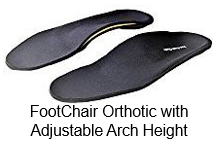
However, if you are outside of the Seattle area, you can opt for a prefabricated orthotic. These OTC orthotics are not nearly as effective as correctly made custom devices, but the best over-the-counter arch supports we have found for runners is the FootChair Medical Grade Orthotic with adjustable arch height.
The FootChair footbed has all of the arch support features we recommend to our running patients including:
 Excellent arch support to improve foot contact and spread force over a large surface area. In addition, the arch height can be adjusted via pads that can be inserted into a pocket under the cover. This allows for maximum support and comfort for almost everyone.
- Deep heel cup to stabilize the heel and limit excessive pronation
- Good metatarsal support
- Appropriate cushioning to improve shock absorbtion
We recommend this running footbed to many patients who find it is very helpful – these are the next best thing to a custom orthotic.
The Best Running Shoes for Your Feet
The right shoe for under pronators (supinators) are ones that provide extra cushioning and shock absorbing capacity. Over pronators need shoes that provide extra stability, or “motion control”. You should also know that, after about 250 miles, shoes lose about 30%-50% of their shock absorbing capacity. The same is true for wet shoes, which may take up to 48 hours to dry out. If you run daily, you may want to consider buying two pairs and using them on alternating days. This will help prolong effective shoe life-span and protect your feet.
Twice every year we evaluate running shoes and publish a list of our favorites. You can use our recommended shoe list to start your search for shoes. Be sure to purchase your running shoes at a store with educated employees. Good Seattle area shoe stores are included on our shoe list.
What to Expect When You Come in for a Running Consultation
On your first visit, we will review your medical history, your running history, and perform a complete clinical examination. We will also perform an initial analysis of your running, so be sure to bring your running shoes and some shorts. We will then provide a detailed and easy to understand explanation of our recommended plan for treatment or further diagnosis.
Because running injuries can involve many complicated biomechanical factors, a more detailed running analysis may have to be performed. This more detailed running analysis using our four camera gait analysis system gives us much more information on foot and lower extremity function during activity. Although we can sometimes perform this exam on the first visit, depending on how long your initial exam takes, this analysis may have to be scheduled for another day.
Depending on the needs of each particular patient, after the first or second visit, we will go over our recommended treatment plan. This may include strengthening, adjustments in training, orthotic devices, shoe recommendations, or physical therapy. Your treatment plan is designed to get you back to activity and prevent future problems.
At the Foot & Ankle Center of Washington, our doctors, Dr. Douglas S. Hale and Dr. Lawrence Z. Huppin are known across the nation as highly skilled orthotic experts who specialize in foot orthotic therapy. When you make an appointment for treatment and relief of running related foot pain, please mention that you would like to discuss the use of orthotics for runners. If you think you might be a candidate for custom orthotics, do not buy new shoes until after your appointment with us – and be sure to bring your current running shoes with you to your appointment.
Call (206) 344-3808 or click here to schedule an appointment online.
Aches and Pains of Running
Even with the best preparation, aches and pains are an inevitable result of a jogging or running regimen. If the pain subsides with slow easy exercise, you may continue. But, if it gets worse, stop the activity and rest. If it persists, call us for an appointment in our Seattle office. Here are some of the most common running-associated injuries we see in our office:
Runner’s Knee – This is the most common pain associated with jogging and is a catch-all term for jogging-related knee pain. One of the most common causes of runner’s knee is excessive pronation of the foot. Several studies have shown that custom orthotics are the best way to alleviate the problem.
Shin Splints – These can be very painful and appear at the front and inside of the leg. Shin splints are caused by running on hard surfaces, over-striding, muscle imbalance, or overuse. Treatment includes changing running technique or insertion of an orthotic device in the shoe. Read more on shin splints.
Plantar fasciitis – Another very common running injury, this is heel pain caused by inflammation of the tough fascia on the bottom of the foot, usually right where the fascia attaches to the heel. Read more on plantar fasciitis.
Calcaneal stress fracture – This is an overuse fracture of the heel bone that can occur in runners.
Achilles tendon bursitis – This is an inflammation of the bursa located at the attachment of the Achilles tendon to the heel.
Achilles tendonitis – This is the most common injury of the Achilles tendon. Read more about Achilles tendonitis.
Extensor tendinitis – This is an inflammation of the tendons on the top of the foot, usually midway along the foot.
Sesamoiditis – This is an inflammation of the tiny little bones located in the ball of the foot near the base of the big toe. Read more about sesamoiditis.
Metatarsal stress fracture – This is an overuse fracture of one of the metatarsals – the long bones that start at the midway point of the foot and run right up to the base of the toes. Read more about metatarsal stress fractures. Morton’s neuroma – This condition is caused by chronic irritation of the interdigital nerve, usually between the third and fourth metatarsals near the toes. Runners often experience a pins and needles or “electric shock” pain with this condition. Click here to read more.
Posterior tibialis tendonitis – Runners may experience pain below the inside of ankle or slightly further along the inside of the foot where this tendon passes underneath the medial malleolus (the inside ankle bone) and attaches into the medial aspect of the foot (navicular bone). Read more on posterior tibial tendonitis.
Peroneal tendonitis – Runners usually experience pain on the outside part of the ankle or lateral edge of the foot up to the base of the fifth metatarsal with this condition. The tendon passes underneath the lateral malleolus (the outside ankle bone) and attaches on the lateral aspect of the foot (cuboid and base of fifth metatarsal). Read more on peroneal tendonitis .
Subungual hematoma – This is bleeding underneath the nail from chronically jamming your toe(s) into your shoes and can occur in runners. A hematoma like this can also happen if you drop something heavy on your toe. Read more about subungual hematomas.
Medical References on Running and Orthotics
A Franklyn-Miller, C Wilson, et al, “Foot orthoses in the prevention of injury in initial military training: a randomized controlled trial,” American Journal of Sports Medicine, 39(1):30-37 (2011).
A Mundermann, BM Nigg, et al, “Foot orthotics affect lower extremity kinematics and kinetics during running,” Clinical Biomechanics, 18(3):254-262 (2003).
A Hirschmuller, et al, “Clinical effectiveness of customized sport shoe orthoses for overuse injuries in runners: A randomised controlled study,” British Journal of Sports Medicine, 10:1136 (2009).
D’Ambrosia (1985), Dugan & D’Ambrosia (1986), Eggold (1981), Kilmartin & Wallace (1994), “The success rate in treating running injuries with orthotics alone has been estimated by various researchers to be between 50 to 90%.”
RL Blake, JA Denton, “Functional foot orthoses for athletic injuries: A retrospective study,” Journal of the American Podiatric Medical Association, 75:359-362 (1985).
ML Gross, LB Davlin, et al, “Effectiveness of orthotic shoe inserts in the long distance runner,” American Journal of Sports Medicine, 19:409-412 (1991).
RC Dugan, RD D’Ambrosia, “The effect of orthotics on the treatment of selected running injuries,” Foot Ankle, 6:313 (1986).
CL MacLean, J Hamill, “Short and long-term influence of a custom foot orthotic intervention on lower extremity dynamics in injured runners,” Annual International Society of Biomechanics Meeting, Cleveland (Sept 2005).
SP Baitch, RL Blake, et al, “Biomechanical analysis of running with 25 degree inverted orthotic devices,” Journal of the American Podiatric Medical Association, 81:647-652 (1991).
A Mundermann, BM Nigg, et al, “Orthotic comfort is related to kinematics, kinetics, and EMG in recreational runners,” Medicine & Science in Sports & Exercise, 35:1710-1719 (2003).
LS Smith, TE Clarke, et al, “The effects of soft and semi-rigid orthoses upon rearfoot movement in running,” Journal of the American Podiatric Medical Association, 76:227-232 (1986).
DS Williams, I McClay-Davis, et al, “Effect of inverted orthoses on lower extremity mechanics in runners,” Medicine & Science in Sports & Exercise, 35:2060-2068 (2003).
C MacLean, IM Davis, et al, “Influence of a custom foot orthotic intervention on lower extremity dynamics in healthy runners,” Journal of Clinical Biomechanics, 21(6):623-30 (2006).
A Hreljac, RN Marshall, PA Hume, “Evaluation of lower extremity overuse injury potential in runners,” Medicine & Science in Sports & Exercise, 32(9):1635-41 (2000).
CL MacLean, IS Davis, J Hamill, “Influence of running shoe midsole composition and custom foot orthotic intervention on lower extremity dynamics during running,” Journal of Applied Biomechanics, 25(1):54-63 (2009).
CL MacLean, IS Davis, J Hamill, “Short- and long-term influences of a custom foot orthotic intervention on lower extremity dynamics,” Clinical Journal of Sports Medicine, 18(4):338-43 (2008).
K O’Leary, KA Vorpahl, et al, “Effect of cushioned insoles on impact forces during running,” Journal of the American Podiatric Medical Association, 98(1): 36-41 (2008).
KB Fields, JC Sykes, et al, “Prevention of running injuries,” Current Sports Medicine Reports, 9(3):176-82 (2010).
SA Meardon, B Edwards, et al, “Effects of custom and semi-custom foot orthotics on second metatarsal bone strain during dynamic gait simulation,” Foot & Ankle International, 30(10):998-1004 (2009).
JR Franz, J Dicharry, et al, “The influence of arch supports on knee torques relevant to knee osteoarthritis,” Medicine & Science in Sports & Exercise, 40(5):913-7 (2008).
