




What Is Short Leg Syndrome?
 Leg Length Inequality (LLI) or Limb Length Discrepancy (LLD), as the names imply, are conditions where the patient’s legs are of different lengths. Many people have marginally different leg lengths that cause no problems at all but when the difference is large enough, treatment for the discrepancy is required. Having one leg shorter than the other (“short leg syndrome”) can lead to a number of problems including pain in the back, hip, knee, and foot.
Video: How to Diagnose and Treat Problems Caused by a Short Leg
In fact, we have seen many patients who have spent years and thousands of dollars trying to figure out why they have back, knee and hip pain only to be told that nothing is wrong with their joints. Simple measurements of their legs could have avoid years of pain and unnecessary medical expense. Dr. Hale and Dr. Huppin are experts at diagnosing short leg syndrome and treating the problems associated with it. For an evaluation, contact us today for an appointment in our Seattle foot and ankle clinic.
How Is Limb Length Discrepancy Diagnosed?
Placing hands on top of pelvis with patient standing – this has been determined not to be accurate since the right and left sides of the pelvis are commonly different heights.
- Directly compare your leg lengths – This can be a good initial screening test, but not able to determine exact measurement of discrepancy.
- Gait analysis. There are some distinctive traits seen in the gait of those who have a short leg. Good screening test but not able to determine exact measurement of discrepancy.
- Diagnostic scanogram x-ray limb length study – able determine difference in femur and tibia length but usually performed non-weight-bearing thus not taking into account foot collapse. Also, has higher amount of radiation exposure and chance of magnification error.
- CT scan – performed non-weight-bearing thus not taking into account foot collapse.
- Standing/weight-bearing study with ruler measurement – most accurate test and able to determine heights of pelvis, femur, tibia and ankles. Foot/ankle collapse changes overall limb length measurement and needs to be determined prior to adding a lift. A ruler is placed behind the patient allowing accurate measurement without magnification error. Also, when utilizing a ruler only the joints have to be x-rayed, thus, limiting the amount of x-ray exposure.
How we diagnose a short leg:
We directly compare your leg lengths and perform a gait analysis. If these screening test suggest you have a short limb and you are symptomatic we send you for a standing/weight-bearing study with ruler measurement. This study allows for accurate measurement of discrepancy and includes your ankle/foot collapse measurement which is necessary to know when adding a lift. Call our office today to set up your study. We use a radiology clinic expert at performing this most effective and reliable method of measuring limb length difference.
What Are the Two Types of Short Leg Syndrome?
There are two types of LLI, anatomical or functional. Functional LLI is the more common of the two.
- Anatomical LLI is when there’s an actual discrepancy in the length of the patient’s legs, with one leg longer than the other.
- Functional LLI is when there’s a biomechanical problem in the hip or pelvis which causes one leg to function as if it were shorter than the other.
What Are the Causes of Short Leg Syndrome?
The most common causes of include:
- Congenital problems including issues with the position of the fetus in the womb.
- Birth defects that cause the legs to develop at different lengths.
- Injuries that occur at the time of birth (for example, a dislocated hip).
- Trauma that affects the growth plate during childhood.
- Fractures or dislocations that affect the leg bones and joints.
- Bone fractures that cause a shortening of the legs during healing.
- Bone infections which can stunt the growth of the leg bones.
- Tumors which hinder blood flow and affect bone development.
- Neuromuscular injuries to the hip or pelvis which causes one leg to be held higher.
- Surgery (for example, a hip or knee replacement) that causes leg length discrepancy.
- Poor posture so that the pelvis is tilted, leaving one side higher than the other.
What Are the Symptoms of Short Leg Syndrome?
It is common for the human body to compensate for a discrepancy in leg length, whether anatomical or functional. Compensation may place unnatural stress on the body including parts of the body which seem unrelated to short leg syndrome – from the feet to the jaw. For example, you may lean toward the short leg and this can put excessive pressure on one hip and knee.
Common symptoms caused by compensation include:
- Joint pain in the hips, knees, back or jaw
- Posture problems that lead to knee and hip injuries
- Limited range of motion in the hips and knees
- Unequal weight distribution at the hips and knees
- Ligament damage in the knees due to limping
- Knee pain in either the short or the long leg
- Nerve pain in the lower back and legs (sciatica)
- Poor coordination or balance
- Pain in the feet and ankles
- Jaw pain (TMJ)
- Tiredness and fatigue
The human body uses pain as a signal that something is wrong. If you are experiencing back pain, knee pain, or hip pain and your physician has been unable to discover the cause, it may well be that you are suffering from Short Leg Syndrome, a condition which requires expert diagnosis and specialized treatment.
How Does the Body Compensate for a Short Leg?
When one leg is shorter, your body works hard to correct the problem and equalize the two legs – this is called compensation. Compensation can be very complicated and vary from person to person, but two common methods of compensation include:
- Leaning towards the short leg in order to extend it and make the leg longer.
- Limping to one side.
- Flattening the foot on the long side to make the leg act shorter (called pronation).
Compensation may help those with a shorter leg to walk more normally but, unfortunately, it also places abnormal force on the feet, ankles, knees, hips, lower back, and even the neck. This can, of course, lead to pain.
What Is the Treatment for Short Leg Syndrome?
To relieve the pain of a short leg — whether the pain is in the feet, ankles, knees, hips, or lower back — our goal is to equalize the length of both legs. We can accomplish this in several ways.
- Building up the sole and heel of your shoes
This technique is especially helpful for those people with large differences (greater than one inch) in their limb length. The problem with this treatment is that it can be a hassle to add a lift to all of your shoes.
- Adding a lift inside your shoe

This is the quickest and simplest method of adjusting for a short leg. The downside is that lifts can wear out quickly and raise only the heel rather than the entire foot. In addition, they do not compensate for the abnormal pronation that often occurs with a short leg. We will often start with in-shoe lifts and then move on to more definitive treatments later. We usually start treatment with this adjustable heel lift. It can be adjusted to 1/8″, 1/4″ and 3/8″. If more lift is needed get more than one and stack the lifts on top of each other.
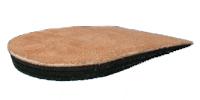
- Prescribing custom orthotics
Custom orthotics for short leg offer the advantage of treating both the short leg AND the abnormal pronation that usually occurs with limb length discrepancy. These comfortable medical devices, made from molds of your feet, will not wear down for years, thus saving you money and pain. Read here why orthotics from the Foot and Ankle Center are likely to be more effective than those from other clinics.
Your orthotics will be designed to also relieve the pain of calluses, neuromas, bunions, ball of foot pain, and other biomechanical defects associated with a short leg. If your leg is short by 1/4 inch or less, you will be able to wear our orthotic in most dress shoes. If the shortage is greater than 1/4 inch, you may need to wear walking shoes, gym shoes, or extra deep dress shoes to accommodate the orthotic.
Also known as Short Leg Syndrome, LLI or LLD can be quite difficult to diagnose, as few physicians have experience with the condition. The doctors at the Foot & Ankle Center of Washington, Dr. Larry Huppin and Dr. Doug Hale, have extensive experience in the conservative treatment of this syndrome, each with more than 20 years of practice in the Seattle area.
Healthy feet allow you to enjoy regular exercise and a happy healthy life. If you have any pain at all that is not relieved by the suggestions above, make an appointment to see us in our Seattle office. We can provide you with conservative treatment options that will relieve your pain.
References – Short Leg Syndrome
O Friberg, “Clinical symptoms and biomechanics of lumbar spine and hip joint in leg length inequality,” Spine 8(6) (Sept 1983): 643-51.
LGF Giles, “Leg Length Inequality,” Spine 6(5) (Sept 1981): 510-518.
AL Nachemson, “Low Back Pain -its Etiology and Treatment,” Clinical Medicine 78 (Sept 1971): 18-24.
CJ Barton, JA Coyle, et al., “The effect of heel lifts on trunk muscle activation during gait: a study of young healthy females,” Journal of Electromyography and Kinesiology, 19(4) (Aug 2009): 598-606.
MC Beal MC, “A review of the short-leg problem,” Journal of American Osteopathic Association 50 (1950): 109-121.
LGF Giles, JR Taylor, “Low back pain associated with leg length inequality,” Spine 6(5) (1981): 510-521.
WA Rush, HA Steiner, “A study of lower extremity length inequality,” American Journal of Roentgenology 56 (1946): 616-623.
AV Fann, “The prevalence of postural asymmetry in people with and without chronic low back pain,” Archives of
Physical Medicine and Rehabilitation 83(12) (Dec 2002): 1736-1738.
JP Gofton, “Persistent low back pain and leg length disparity,” Journal of Rheumatology 12(4) (1985): 747-750.
RL Blake, H Ferguson, “Limb length discrepancies,” Journal of the American Podiatric Medical Association 82(1) (1992): 33-38.
SJ Okun, JW Morgan, et al., “Limb length discrepancy: a new method of measurement and its clinical significance,”
Journal of the American Podiatric Medical Association 72(12) (1982): 595-599.
LGF Giles, JR Taylor, “Lumbar spine structural changes associated with leg length inequality,” Spine 7(2) (1982): 159-162.
AV Fann, R Lee, et al., “The reliability of postural x-rays in measuring pelvic obliquity,” Archives of Physical
Medicine and Rehabilitation 80(4) (April 1999): 458-61.
AL Woerman, SA Binder-MacLeod, “Leg length discrepancy assessment: Accuracy and precision in five clinical methods of evaluation,” Journal of Orthopaedic & Sports Physical Therapy 5 (1984): 230-239.
C Christmas, et al., “How common is hip pain among older adults?” Journal of Family Practice 51(4) (2002): 345-8.
