




Video: Turf Toe Causes and Treatment
What Is Turf Toe?
The term “Turf Toe” is often used to describe any injury to the big toe joint. In reality, it is a very specific big toe joint injury. The big toe joint, also known as the first metatarsal-phalangeal joint or 1st MTPJ, is designed to bend upward when we walk forward. Under the 1st MPTJ, there are two small bones known as sesamoids which are embedded in a tendon that attaches to the big toe. The sesamoids function as miniature pulleys, assisting in toe motion.
The sesamoid bones slide back and forth as the big toe moves up and down. But if the big toe joint is moved beyond its normal range of motion during activity, the ligaments surrounding the joint can be torn or stretched. Torn or stretched ligaments are known as a sprain, so Turf Toe is a sprain of the big toe joint. This injury often occurs during an abrupt change of direction in soccer or a tackle in football if the cleated shoe becomes too fixed to the ground.
Treatment of Turf Toe
If you think you might have turf toe, or any injury to the big toe joint, make an appointment today to see us in our Seattle office. If not treated properly, toe joint injuries can lead to long-term disability including arthritis, so don’t try to treat joint injuries yourself at home. When you come in for a consultation about your toe, here’s the process:
- We perform a complete evaluation of the injured area in order to determine your specific diagnosis.
- X-rays will likely be taken to help rule-out a fracture or dislocation.
- Advanced imaging studies such as bone scan, CT scan or MRI may be necessary in some cases.
- Once we have determined the nature and extent of the injury we will start treatment.
Our goal is to get you back to your routine as fast as possible while ensuring that the joint is completely healed and will not cause long-term problems. To accomplish this, understanding the mechanism of the injury is important so we can modify it, if possible. Depending on the extent of the injury, we may recommend:
- Rest
- Anti-inflammatory care
- Strapping and/or immobilization
- Walking boot (removable cast) or a steel insole for your shoe may be required.
- Custom orthotic to help joint function, prevent further injury and speed recovery may be recommended.
Home Treatment Tips for Turf Toe
Turf toe should not be taken lightly. If not treated correctly it can cause long term disability. So we highly recommend that you see a doctor if you think you might have turf toe or another sprain of the toes. If you are in Seattle come see us for a consultation for your big toe joint pain, if you cannot see a podiatrist for some reason or you want to try home treatment first, below are some suggestions for self treatment of turf toe.
If you do not have 100% relief within two weeks of following all of the instructions below, we strongly recommend you consult a podiatrist.
To treat turf toe and relieve the associated pain, you need to:
(1) Transfer force off of the big toe joint
(2) Limit motion of the big toe joint
We recommend the following four products to try and treat your turf toe at home. These are the products we recommend to our patients and they are also affiliate links so we may receive a small commission at no additional cost to you if your order from the link.
1. Use a walking boot for the first two weeks after injury.
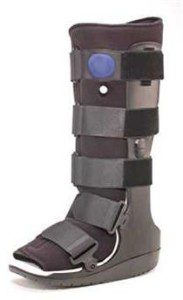
A walking boot will protect the joint during the first couple weeks to help with proper healing. Here is quality boot at a low cost.
2. Use an arch support to transfer pressure off of the big toe joint.
An arch support with a higher arch and some rigidity will work best.
The best OTC arch support that we have found for turf toe is the FootChair 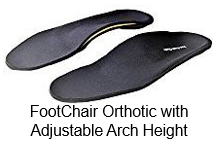 Medical Grade Orthotic.
FootChair orthotics have a stable arch to start with plus they come with additional pads that can be added (up to two) to a pocket under the cover. This allows the arch to be increased for more support. For turf toe we recommend using both the extra pads if they are comfortable in order to maximally transfer pressure off of the injured joint.
 3. Use a turf toe plate to limit motion of the big toe joint.
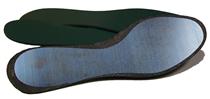
These steel inserts go into your shoe, under the arch support. We often recommend this Turf Toe Plate.
 4. Use sandals or slippers with arch support when you can’t wear shoes.
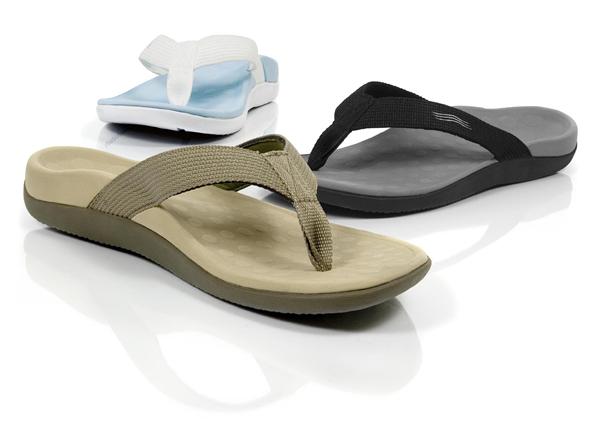
A sandal with an arch support is great to wear around the house to decrease pressure on the ball of your foot. We highly recommend the Vionic Flip-flops or slippers. They have the best arch support of any sandal or slipper on the market.
If you think you might have turf toe, or any injury to the big toe joint, make an appointment today to see us in our Seattle office.
