




Common Ankle Fracture and Foot Fracture Guide
If you think you may have a broken bone in your feet or ankles, call today to make an appointment in our Seattle office. Fractures (broken bones) are common injuries of the foot and ankle. Because our foot and ankle rarely get any real rest, it is important to have proper treatment of any foot fracture or ankle fracture as soon as possible.
If you have a protruding bone broken through your skin, go to the ER immediately. Otherwise, you can make an urgent appointment to see your podiatrist. After you book an appointment for as soon as possible (be sure and let our staff know that you suspect a possible fracture), begin R.I.C.E. therapy at home.
This includes:
- Rest – Do not put weight on your injured foot or ankle and use crutches or a cane to help.
- Ice – Ice your foot 10 minutes on, 10 minutes off continually.
- Compression – Wrap with an Ace wrap but not too tightly and loosen if it gets snug.
- Elevation – Elevate your foot and keep it elevated.
Many foot fractures are so small they do not show up on regular x-rays. It is critical to have these treated by an expert in foot fractures. Smaller foot fractures are often missed in emergency rooms, leading to a worsening of the problem. You should never ignore pain in your foot or ankle – contact our office or get it checked out in the ER then see us for follow-up.
If you suspect a broken bone and we are not available, go to the ER or urgent care right away.
There are many different types of broken foot bones and broken ankle bones.
Do You Have a Foot or Ankle Fracture?
Did you know that about 10% of all fractures occur in the foot and ankle? Even though foot fractures are common, many people put off treatment believing that their injury is not serious. In children, fractures are more common than sprains. When certain types of fractures do occur, they can be hard to identify.
If you have a broken foot or ankle, you may think you will realize it. But, in fact, we regularly see patients in our Seattle Foot and Ankle Center who don’t know. They often ask if their foot or ankle is fractured or sprained. Surprisingly, our answer is sometimes “both.” Many patients mistake a broken ankle for a sprain and most do not realize that you can have both a sprain and a break – in the same foot at the same time.
The human foot is a beautifully crafted to meet its function but, with 26 bones in the adult foot, there are many bones which can be broken. Since our feet are the foundation of virtually every physical action we take, they are rarely allowed to rest. As a result, an untreated foot fracture can progress from an acute to a chronic condition very quickly, with resulting long-term pain.
Healing a broken foot can be a challenge because they are in use all the time yet proper treatment is critical for effective healing and long-term comfort. The podiatrists at the Foot and Ankle Center of Washington are nationally recognized experts in foot biomechanics and treating foot and ankle fractures. If you think you may have a sprain or fracture, make an appointment with us today.
Is Your Foot or Ankle Fractured or Sprained?
A fracture is a break in the bone – it may be either a partial break or a complete break. The severity of the fracture depends on the type and location of the break. Ankle sprains, on the other hand, are injuries to the ligaments surrounding the ankle. Many patients confuse the pain of a fracture with a sprain. Sprains are very common especially among athletes, joggers, tennis players, and many Weekend Warriors. One growing area of foot fractures we have seen is in soccer players – both professional and recreational athletes.
What Are the Symptoms of a Broken Ankle or Foot?
Not every fracture is debilitating – a surprising number of patients with less severe or partial breaks are able to walk. The fact that you are able to handle the pain and continue walking should not be the deciding factor in whether you seek medical attention. Even a sprained ankle, if left untreated, can lead to long-term problems, such as unstable ankles.
If you have any of the following symptoms, you should seek treatment ASAP:
- Pain at the location of the break – it may be debilitating and may extend from foot to knee
- Bruising at the location of the break that develops soon after the injury
- Significant swelling at the location of the break or running the length of the injured leg
- Asymmetry of your ankles – the broken ankle will look different from the other
- Bone protruding through the skin indicates a compound fracture
What Are the Most Common Types of Foot and Ankle Fractures?
- Calcaneus Fracture (Broken heel bone)

2-Calcaneal fracture due to trauma.

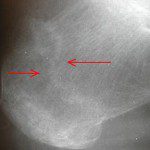
1-Calcaneal/heel bone stress fracture
The calcaneus is the heel bone. Heel bone fractures caused by daily activities are called calcaneal stress fractures (figure 1).Calcaneus fractures caused by trauma can be severe and often lead to chronic pain in the foot and traumatic arthritis (figure 2). Treatment for a broken heel bone depends on the severity of the fracture.

- Talus Fractures (Broken ankle bone)

3-Talus fracture
A talus/lower ankle joint bone fracture is a break of the main ankle bone (figure 3). Talus fractures are serious and often require surgery. Even with surgical treatment, patients can develop long term problems such as arthritis in the ankle or subtalar joint.

- Broken ankle

4-Ankle fracture
Ankle fractures (figure 4) are common injuries and should be treated immediately to help prevent long term problems. Call us immediately if you think you have fractured your ankle.

- Fifth Metatarsal Shaft Fracture

Fifth Metatarsal Shaft Fracture
If you twist and injure your foot you may break the shaft of the fifth metatarsal (the long bone behind the fifth toe). It’s sometimes called a “Dancer’s fracture” since it may occur while standing on your toes. It’s treated with casting or surgery depending on the severity of fracture.

- Fifth Metatarsal Tuberosity Fracture
If you twist your ankle, the tendon on the outside of your foot pulls and may fracture the base of the fifth metatarsal (the long bone behind the fifth toe). Tuberosity fractures can usually be treated with casting and a short period on crutches.
- Metatarsal Stress Fracture

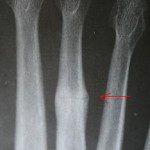
5-Metatarsal stress fracture
A metatarsal stress fracture (figure 5) is a common cause of pain on top of the foot, especially when people suddenly increase their activity level. This is the most common type of stress fracture. This injury is very common in new soldiers and thus is also called a “march fracture.” Read more here.
- Jones Fracture

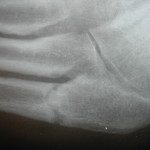
6: Jones fracture/fracture
A Jones fractures (figure 6) is a fracture of the fifth metatarsal bone of the foot, just 1.5cm forward of a tuberosity fracture. This fracture causes pain over the middle/outside area of the foot, swelling, and pain when walking. Because of poor blood supply to this area, it often does not heal well without proper treatment and requires casting, crutches and, possibly, surgery.
- Navicular Stress Fracture

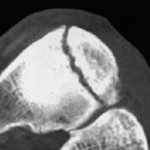
7-navicular stress fracture
A navicular stress fracture (figure 7) is an injury to the bone on the inside of the foot between the ankle bone and the midfoot. This stress fracture often causes vague pain in the midfoot that hurts during activity. Treatment usually involves immobilization in a cast or walking boot for several weeks. Orthotics are often used after healing to prevent return of the stress fracture.
- Lisfranc Fracture

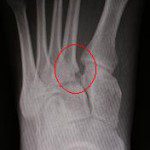
8-Lisfranc midfoot fracture
This is both a fracture and a dislocation of the joints in the middle of the foot (figure 8) and is a very serious injury that usually requires surgical repair. Without surgical repair, nearly 100% of these injuries go on to cause severe arthritis of the midfoot.
- Toe Fractures

9-Toe Fracture
Contrary to popular belief, toe fractures (figure 9) should always be treated in order to prevent long-term problems. Click here for detailed information on toe fractures.

What is the Most Common Stress Fracture of the Foot and Ankle?
A metatarsal stress fracture is a break in the bone of the top of the foot as the result of repetitive stress on that foot. It will usually begin as a small crack in the cortex (i.e., outer shell) of the bone. You will likely not even be aware of the break except that you begin to experience pain on the top of your foot. Metatarsal stress fractures are the most common stress fracture of the foot and ankle region.
What Are the Causes of Metatarsal Stress Fracture?
There can be a number of causes of metatarsal stress fractures, but the most common include:
- Decreased bone density (i.e., osteoporosis)
- Unusual stress on a metatarsal due to poor foot position or a deformity in the forefoot (e.g., bunion)
- Abnormal foot structure or abnormal foot mechanics (e.g., flatfoot)
- Sudden increase in physical activity, especially exercise without proper conditioning
- Obesity
- Poorly fitted, unstable shoes
- Excessive, repetitive stress to the foot (e.g., running a marathon)
You will likely not be able to identify a single incident which caused the fracture such as smashing your toe against something. It is repetitive stress, usually caused by repetitive motion, that causes a metatarsal stress fracture.
How Can You Prevent a Metatarsal Stress Fracture?
The best way to avoid metatarsal stress fractures is to prevent stress on the vulnerable toe. This is best accomplished through the use of custom made and personally fitted orthotics, which will better distribute your weight throughout the foot and reduce the stress of carrying weight on the toe which might otherwise be affected.
What Doctor Should You See to Treat a Foot Fracture?
The best doctor to treat a broken foot is one with a wide range of experience treating foot fractures and a variety of foot conditions including foot pain, unstable ankles, plantar fasciitis, bunions, big toe pain, ankle sprains, stress fractures, and Neuromas.
The doctors at the Foot and Ankle Center, Dr. Douglas S. Hale and Dr. Lawrence Z. Huppin, are nationally recognized and respected foot and ankle physicians, with advanced training, decades of experience, and highly respected credentials. If you suspect you have a foot fracture and live in the greater Seattle area, come see us for expert treatment of your injury.
Will My Foot Fracture Require Surgery?
 Due to its complexity and the down-time required for patient recovery, foot surgery should always be a last resort. However, there are situations where foot surgery is unavoidable. Surgery should only be considered when all other options have failed or are impractical and ineffective. It is imperative that you visit your podiatrist as soon as possible if you have injured your foot.
What you believe to be a simple sprain may instead be a partial fracture, which may worsen without proper examination and treatment. A simple foot injury which may have been resolved conservatively if timely treatment was sought may eventually require surgery if left untreated.
Some of the factors to be considered to determine if surgery for your foot fracture is required include:
- Is the break a complete or partial fracture?
If the fracture fully transects the bone from cortex to cortex or from edge to edge, the bone may less stable during healing, which may reduce the potential to heal.
- Has the broken bone remained in proper alignment?
Despite the break, if the bone remains in proper anatomical alignment, the healing potential is strong. In contrast, a significant shift in the affected bone will require surgery.
- Is there a large gap in the bone fracture?
If the two pieces of broken bone are near to each other, conservative treatment will likely succeed. However, if the broken bone shows a gap of more than 2mm, surgery will be required.
- Is the bone or adjacent joint dislocated as well?
A dislocated toe can usually be treated conservatively in our office if you see us within 24-36 hours. If the broken bone or adjacent joint is also dislocated, surgery will usually be required, especially for larger bones.
Once the surrounding soft tissues begin to tighten up around a dislocation or fracture, it may be virtually impossible to repair without surgery. The best way to avoid foot surgery which may otherwise be unnecessary is to see your podiatrist within 24 hours of an acute foot injury.
The doctors at the Foot and Ankle Center of Washington have a national reputation for successfully treating a wide variety of foot injuries using conservative methods, we may recommend foot surgery for a foot fracture under certain conditions – and we offer surgical expertise you can trust.
Contact Us Immediately If You Suspect a Foot Fracture
You should make an appointment to see us immediately in our Seattle foot and ankle clinic if you think you might have fractured your foot to avoid long-term, chronic foot problems that can result. Tell our receptionist that you might have a fracture to get an urgent appointment. If you think you might have fractured your foot, ankle, or toe, avoid bearing weight on it until you come in to see us.
Our doctors, Dr. Douglas S. Hale and Dr. Lawrence Z. Huppin, have each been named Seattle’s top doctors five times in the past eight years and have been recognized as Washington State Podiatrist of the Year. They are nationally known experts and are highly respected as the Seattle foot fracture experts, specializing in conservative, non-surgical treatment whenever possible.
If you live in the greater Seattle and Puget Sound area, call (206) 344-3808 to see us in our Seattle office as soon as possible, for diagnosis, treatment, and relief by the Seattle foot fracture specialists. We are located in Seattle just off I-5 and our foot clinic is convenient to Bellevue, Issaquah, Mercer Island and Kirkland – near Swedish Medical Center in downtown Seattle.
