




Shockwave Therapy for Heel Pain and Other Musculoskelatal Conditions at the Foot & Ankle Center of Washington
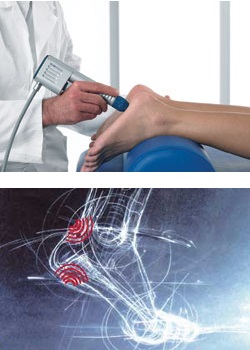
Advanced Relief for Chronic Foot, Tendon and Heel Pain utilizing Extracorporeal Shockwave Therapy (ESWT) with Drs. Hale, Huppin, and Kashani.
At the Foot and Ankle Center of Washington, we offer non-invasive, cutting-edge treatment for chronic foot and heel pain through Extracorporeal Shockwave Therapy (ESWT). If you’ve been struggling with plantar fasciitis, Achilles tendinopathy, or other soft tissue injuries, ESWT may be the breakthrough you need—without surgery, downtime, or medication.
Our ESWT clinic is led by nationally recognized podiatrists who are experts in evidence-based, patient-focused foot and ankle care.
What is ESWT?
Extracorporeal Shockwave Therapy uses targeted acoustic energy to stimulate the body’s natural healing response. This FDA-cleared treatment helps regenerate damaged tissue, reduce inflammation, and relieve pain by increasing blood flow and triggering cellular repair mechanisms.
Why Choose Us?
Experienced Team In Shockwave Therapy: Over 40 years of combined podiatric expertise.
Personalized Care: Every ESWT treatment plan is tailored to your condition and activity level.
Proven Results by on evidenced based medicine.
Convenient Location: Centrally located in Seattle for easy access
What to Expect:
Each session takes about 20 minutes, and most patients require 3–5 treatments spaced initially 1 apart and later treatments may be weeks apart. ESWT is performed in-office and requires no anesthesia, injections, or recovery time, allowing you to return to daily activities immediately.
Shockwave Therapy is a non-invasive, non-surgical treatment option for treatment of ligament, tendon and bone injuries. It is very effective at stimulating healing of tissues that otherwise seem to be stuck in a non-healing state.
What Conditions Can Be Treated with Shockwave Therapy?
We use shockwave for many tendon and ligament conditions. These include:
- Plantar fasciitis
- Achilles tendonitis
- Tendonitis including peroneal tendonitis and posterior tibial tendonitis
- Sesamoiditis
- Ball of foot pain (capsulitis)
- Shin splints
How Does Shockwave Work to Repair Damaged Tissue?
When high pressure shockwave is applied to damaged tissue it stimulates healing of those tissues through several mechanisms. These include:
-
- Neo-vascularisation: Shockwave therapy helps create new blood vessels locally. The improved blood flow helps tendon heal.
- Release of growth factors: Growth factors are proteins that stimulate tenocytes – the cells that repair tendon.
Additionally, shockwaves help to over-stimulate pain transmission nerves, which can lead to a reduction in sensitivity and pain.
Schedule an Appointment to Discuss Shockwave Therapy
Why Consider Non-Invasive Shockwave Treatment for Heel Pain and other Musculoskelatal Conditions?
- Shockwave therapy has been shown in a number of studies (see below) to be a very effective treatment for heel pain, tendonitis and other ligament and tendon injuries. In fact, it is more than 70% effective for these types of injuries in most studies.
- Shockwave is completely non-invasive and has no dangerous side effects.
Video: How Does Shockwave Therapy Work?
How Long Do the Treatments Take and How Many Will I need?
Treatments take less than 10 minutes. Generally, 3 – 5 treatments are necessary at weekly intervals. Patients are evaluated for success at 16 weeks after the first treatment.
What Results Can I Expect?
- In general it takes 8 – 12 weeks to see initial improvement
- Maximum improvement is usually seen at about 12 weeks after the final session
Keep in mind that this isn’t like a steroid injection where rapid results can be seen. What shockwave does is stimulate the bodies healing process, so it takes a number of weeks to see results. Most of the best studies we have found show about 70% of patients with chronic heel pain due to plantar fasciitis or Achilles tendonitis will find relief with EPAT therapy. In general we see about one third of patients have excellent results, one third see moderate improvement and about one third see no improvement. And although some patients don’t see improvement we have seen absolutely no complications from the procedure.
How is the Shockwave Treatment Performed?
Coupling gel is applied to your foot in the area requiring treatment. EPAT pressure waves are then released via the applicator while moving it over the treatment area.
Is it Safe?
Yes. There are a tremendous number of clinical studies and tests that have confirmed its effectiveness and safety. In fact, for most patients EPAT has virtually no side effects, risks or complications.
Who should receive Shockwave Therapy?
People with the following conditions can often benefit from shockwave therapy:
 Plantar Fasciitis:
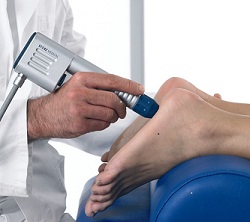 Plantar Fasciitis:
- Shockwave therapy treatment has been shown to be one of the most effective treatments for plantar fasciitis with the highest level of medical evidence for treating this condition.
- You can learn exactly how Shockwave fits into an overall plantar fasciitis treatment plan in our Plantar Fasciitis Treatment Guide.
- Shockwave is about 70% effective in relieving plantar fasciitis pain and has no side effects or complications.
- Shockwave is done in combination with treatments to decrease load on the plantar fascia which might include orthotics, walking boots, activity modification and weight loss.
In years past, surgical intervention for chronic plantar fasciitis was required when these other treatments had failed. Today, Shockwave is available as an alternative, non-invasive treatment option.
Achilles Tendonopathy / Tendonitis:
Current studies show that shockwave should be incorporated as an initial treatment along with eccentric exercise and reducing tension on the tendon. Go to our Achilles Tendonitis Treatment Guide for detailed information. Shockwave has been shown to be effective for Achilles pain in the tendon itself and at the Achilles tendon attachment on the heel bone. In fact there is Level 1 evidence (the highest level of medical evidence) showing:
- For mid-portion Achilles tendonopathy 56% of patients had complete recovery with eccentric exercise alone and 82% of subjects had complete recovery at 4 months with a combination of shockwave therapy and eccentric exercise11. More information on shockwave treatment of mid-portion Achilles tendon pain can be found in this article.
- For insertional Achilles tendonopathy 28% of patients had relief with eccentric exercise alone and 64% with a combination of shockwave therapy and eccentric exercise12. More information on treatment of insertional Achilles tendon pain is found in this article and this article.
Medial Tibial Stress Syndrome (Shin Splints)
Three studies have been done on the use of shockwave therapy for treatment of medial tibial stress syndrome. Two of those were very positive for the use of shockwave therapy in relieving shin splint pain. One of the studies was inconclusive.8-10
Sesamoiditis
A preliminary study has shown very good results for treating sesamoid pain with shockwave therapy. Larger studies are ongoing. Results so far are very promising13.
Peroneal Tendonitis, Posterior Tibial Tendonitis and Capsulitis
Shockwave is used on tendon and ligament conditions throughout the body to stimulate healing of damaged tissue.
In the foot and ankle region we commonly use shockwave to treat peroneal tendonitis, posterior tibial tendonitis and capsulitis of the ball of the foot.
Who should not receive Shockwave treatment?
Your health history will be reviewed by your doctor to see if this treatment is appropriate for you. Shockwave is not recommended for patients with certain conditions. Patients with pacemakers and patients taking medications that may prolong or interfere with blood clotting (Coumadin) are not candidates for shockwave. Also, children or pregnant women are not considered appropriate candidates. Shockwave is usually not needed for patients who have had plantar fasciitis for a very short period of time as those patients usually respond quickly to less expensive treatments.
What are the side effects of Shockwave Therapy?
Radial shockwave therapy has virtually no serious side effects, especially when compared to surgery and even injections. Also, there is no down time at all.
The most common patient complaint is some minor pain or discomfort during and after treatment. Other side effects might include minor skin bruising, reddening, or swelling of the treated area. However, these possible occurrences usually resolve within a few days. The risks associated with surgery and general anesthesia are eliminated. Shockwave therapy is FDA cleared and is used all over the world.
How Does Shockwave Therapy Work?
For over thirty years, extracorporeal shockwave lithotripsy (ESWL), a non-invasive procedure, has been successfully used in the treatment of kidney stones.
As the force of a shockwave causes the disintegration of the kidney stone, so does the acoustic energy promote healing in the distressed tissue. Shockwave therapy produces a regenerative and tissue-repairing effect in musculoskeletal tissues, The shockwave stimulates and reactivates healing through revascularization (creation of new blood vessels), differentiation of stem cells (creating more of the cells that cause tissue to heal) and other elements necessary to advance normal tissue healing.
This article reviews the biologic healing effects of shockwave therapy.
Insurance Coverage for Shockwave Therapy
Insurance does not cover the cost of the shockwave procedure. If you have a HSA or Flexible Spending Account (FSA) through your employer, you can usually use HSA or FSA funds to pay for the procedure. This can be confirmed with your plan administrator.
How Much Does Shockwave Therapy Cost?
EPAT shockwave costs $200 per session and we follow a 6 session protocol. Ideally shockwave should be done initially 3 weeks in a row. The final 3 sessions should be done over a 6 week period.
- Most studies recommend approximately 6 sessions for best clinical outcomes.
- We will see you back 16 weeks after the first shockwave session for a regular office visit. At that time you should see maximum benefit from shockwave.
The cost for 6 sessions of shockwave for two feet (or two separate locations on one foot) at the same time is $1900. According to most studies, EPAT is successful about 80 – 85% percent of the time for plantar fasciitis and mid-portion achilles tendonitis. Payment is due prior to the procedure being performed.
Is Shockwave Therapy Safe for Pregnant Patients?
EPAT is a safe treatment, but has never been tested on pregnant patients. We advise that you wait at least 3 months post partum before treatment, as many foot pains subside after weight loss and hormonal equilibrium is reached.
Benefits of Non-invasive EPAT Shockwave Therapy.
- Over 70% successful in relieving pain of plantar fasciitis and Achilles tendonitis.
- Patients can bear weight immediately. No need to wear a walking boot after the procedure.
- No surgery or the risks of surgery.
- Patients can return to work immediately.
- Most patients return to strenuous activity after 4 weeks.
- Completely non-invasive so there is no future treatment options are not affected.
- Cost effective.
- Reduces need for other treatments.
- Helps patients return to activity faster.
- Fast, safe and effective.
- No anesthesia required.
References
- Chew KT. Comparison of Autologous Conditioned Plasma Injection, Extracorporeal Shockwave Therapy, and Conventional Treatment for Plantar Fasciitis: A Randomized Trial. nPM R. 2013 Aug 22.
- Saxena A, Fournier M. Comparison between extracorporeal shockwave therapy, placebo ESWT and endoscopic plantar fasciotomy for the treatment of chronic plantar heel pain in the athlete. Muscles Ligaments Tendons J. 2013 Jan 21;2(4):312-6.
- Kudo P. Randomized, placebo-controlled, double-blind clinical trial evaluating the treatment of plantar fasciitis with an extracoporeal shockwave therapy (ESWT) device: a North American confirmatory study. J Orthop Res. 2006 Feb;24(2):115-23.
- Al-Abbad H, Simon JV. The effectiveness of extracorporeal shock wave therapy on chronic achilles tendinopathy: a systematic review. Foot Ankle Int. 2013 Jan;34(1):33-41.
- Moen MH. Shockwave treatment for medial tibial stress syndrome in athletes; a prospective controlled study. Br J Sports Med. 2012 Mar;46(4):253-7.
- Saxena A. Extra-corporeal pulsed-activated therapy (“EPAT” sound wave) for Achilles tendinopathy: a prospective study. J Foot Ankle Surg. 2011 May-Jun;50(3):315-9.
- Furia JP. High-energy extracorporeal shock wave therapy as a treatment for insertional Achilles tendinopathy. Am J Sports Med. 2006 May;34(5):733-40.
- Newman, P. Shockwave treatment for medial tibial stress syndrome: A randomized double blind sham-controlled pilot trial. Newman P, et al. J Sci Med Sport. 2016
- Winters, M. Treatment of medial tibial stress syndrome: a systematic review. Sports Med. 2013
- Moen, et al. Shockwave treatment for medial tibial stress syndrome in athletes; a prospective controlled study. Br J Sports Med. 2012
- Rompe JD, et. Al Eccentric loading versus eccentric loading plus shock-wave treatment for midportion achilles tendinopathy: a randomized controlled trial. Am J Sports Med. 2009
- Rompe JD.Eccentric loading compared with shock wave treatment for chronic insertional achillestendinopathy. A randomized, controlled trial.J Bone Joint Surg Am. 2008
- Saxena, A. Radial Soundwave for Sesamoidopathy in Athletes: A Pilot Study. Journal of Foot and Ankle Surgery. 2016
Schedule an Appointment to Discuss Shockwave Therapy for Your Foot or Ankle Condition
