




Video: How Orthotics Can Help Treat Some Cases of Back Pain
Solutions Using Foot Orthotics for Back Pain and Hip Pain
Back pain will affect up to 80% of the people in this country at some point during their life. In fact, back pain is the second most common reason people seek medical care.1 Recent research in Seattle using a standing MRI has shown reduction of protruding disc while patient stands on inverted platform. Supporting the use of orthotics in treating some back conditions.
Hip pain on a regular basis affects about 15% of people over 60 in the United States.13
Foot function can play a role in some cases of back and hip pain. In fact, in a 1999 study of patients with low back pain, gait abnormalities were detected in all patients. Eighty four percent of the patients studied experienced improvement with the use of custom foot orthotics. All of the study participants had not responded to standard treatments which had included spinal manipulation, physical therapy, therapeutic injections and/or surgery.2
In a 2013 study patients with chronic low back pain, those patients using foot orthotics in addition to the usual care had greater improvement than those who did not use them.4
Although there have been a number of studies on the effects of foot orthotics in treating back pain and knee pain, there has been less research on the use of foot orthoses in treating hip pain. In fact, we were not able to find any significant studies. Given that, however, some patients with hip pain do respond to shoe therapy and orthotic therapy.
Biomechanical Evaluation and Orthotics Protocol for Back Pain and Hip Pain
At the Foot & Ankle Center, Drs Hale and Huppin have a very specific approach to hip and back pain treatment. In general, we use the following protocol;
- Step 1 is to Evaluate whether foot pain is a probable contributor to back or hip pain.We do this through a history, physical exam, biomechanical exam and gait evaluation. In some cases we can determine in the office whether or not your lower extremity function is likely contributing to your back pain. In other cases we do testing of the effects of changing foot function using taping and temporary orthotics. Once done, we will let you know if we feel that your foot function is contributing to back pain. If we do not feel that your feet are contributing to your back pain we will refer you to an appropriate back specialist. If it does appear that foot function might be playing a role in your back pain, however, then we move on to step 2.
- Step 2 is to correct abnormal lower extremity biomechanical function that may be playing a role in your postural pain. Often this will be through the use of custom foot orthotics. In most cases of foot function related back pain, our goal with orthotics is to decrease excessive pronation (flat-footedness) and / or to achieve symmetry between the right and left foot (ensure that the left and right feet are functioning in the same way and at the same speed).

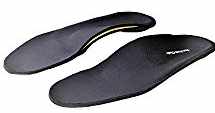
FootChair Adjustable Arch Orthotic
The best OTC arch support we have found for back pain is the FootChair Medical Grade Orthotic. The FootChair adjustable arch orthotic has the best arch height we have found on an over-the-counter arch support. It is the only OTC orthotic to have an adjustable arch using removable pads.
- Step 3 is to modify the orthotics. In treating back or hip pain, it is imperative that we not only limit excessive motion, but also try to achieve symmetry between the left and right feet. To achieve this we may add lifts, cushions, pads or cut-outs to the orthoses. 90% of the time, we will be able to determine the appropriate orthotic prescription and necessary modifications via our in-office biomechanical evaluation and gait analysis. We have a camera system at our office to help evaluate your gait.
- Having one leg shorter than the other can also cause back pain and/or hip pain and evaluation of limb length discrepancies is part of our back pain work-up.4-11 We will measure limb length in the office and you may also be referred for a sophisticated x-ray evaluation of limb length called a scanogram or standing x-ray study. In Seattle we are lucky to have several facilities that provide a standing limb length study. The standing study is preferred since it takes into account asymmetrical foot flattening/position.
Video: Can Foot Orthotics Be Used to Treat Hip Pain?
Back Pain from Running
Acute or chronic back pain can be one of the most frustrating physical problems to solve. Back pain from running can be even more frustrating however, because it can develop from so many causes. If you’ve already ruled out all of the usual suspects, all of the biomechanical issues such as sprain, strain, scoliosis, etc., perhaps the pain you experience during or after your runs is due abnormal foot function.

What are the conditions which might contribute to back pain from running? The variety may surprise you but, flat feet, high arches, over-pronation and under-pronation, unequal leg lengths, and an uneven pelvis, just to name a few. To give yourself immediate relief, you should immediately cut back on your mileage; then make an appointment to see us for an evaluation of your feet to see if they are causing the problem.
The good news is that, generally speaking, if your back pain from running is due to abnormal foot function, it can often be relieved through the application of custom orthotics; that is, a prescription insole to provide additional support and stability while running. Doctors Huppin and Hale specialize in the prescription and application of orthotics for runners, having helped literally hundreds of patients overcome heel and arch pain and back pain caused by running.
It may also be time to replace your old favorite running shoes, as most shoes designed for running begin to lose their shock absorption characteristics after about 400 miles; which seems to be the critical mileage for increased pain. If your shoes are still in good shape, you may need a different style or brand, and your podiatrist can help you with the selection of the best running shoe for you, as well.
If you have begun to experience back pain from running, or if it has been a chronic problem for you, you should definitely make an appointment to see us as soon as possible for a comprehensive evaluation and diagnosis. Also, make sure to bring along your favorite running shoes for an evaluation of their condition.
Back Pain, Lower Extremity Weakness and Orthotics
If you want more detailed information on how orthotics might help reduce back pain and weakness of the lower extremities due to nerve compression in the back, the following video has excellent information. This is a video of an academic lecture by our colleague Dr. Stanley Newell. Dr. Newell, who recently retired, is a pioneer in lower extremity sports medicine and practiced in Seattle for many years.
References: Foot Orthotics and Back Pain
- Carey TS, Evans A, Hadler N, et al. Care-seeking among individuals with chronic low back pain. Spine 1995;20(3):312-317.
- Dannenberg, Guiliano. 1999. Chronic low-back pain and its response to custom-made foot orthoses. Journal of the American Podiatric Medical Association.
- Botte RR. An interpretation of the pronation syndrome and foot types of patients with low back pain. J Am Podiatry Assoc 1981;71(5):243-253.
- Ferrari R. Effect of customized foot orthotics in addition to usual care for the management of chronic low back painfollowing work-related low back injury. J Manipulative Physiol Ther. 2013
