




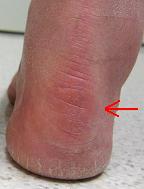
Bump Back of Heel.
The back of your heel is the second most common location for heel pain (first is the bottom of the heel, usually due to plantar fasciitis). Along with back of the heel pain, your heel may be sore and tender to touch or swollen. Shoe pressure, standing and walking can aggravate back of the heel pain. This type of foot ailment is most common in those who wear tight shoes, high heels, are overweight or very active.
Video: How to Treat Pain at the Back of the Heel
If you’ve got serious back of heel pain, make an appointment to see us right away – we are Seattle’s heel pain specialists and can usually relieve your pain very quickly in a very conservative manner. Surgery is not usually necessary but, if conservative therapy fails, is an option of last resort to get you pain-free.
The following information refers to pain at the very back of the heel, not for treating Achilles tendonitis – which usually causes pain just above the heel bone. A complete guide to Achilles tendonitis can be found here.
Four Most Common Causes of Pain in the Back of the Heel
- Haglund’s Deformity
- Insertional Tendonitis or Tendinosis
- Achilles Insertional Calcific Tendinosis (AICT)
- Retrocalcaneal Bursitis
What Is Haglund’s Deformity (Pump Bump)?
This cause of back heel pain is also known as “pump bump.” The deformity is a bump of bone on the upper part of the back of your heel bone (called the calcaneus) that has become enlarged. This bump can trap the soft tissue of the Achilles tendon between the heel bone and the shoe resulting in irritation of the Achilles tendon, the skin and other soft tissue on the back of the heel. It can also cause painful bursitis (inflammation of a fluid-filled sac between the tendon and bone).
What Causes Haglund’s Deformity?
This type of pain is sometimes called “pump bump” because the back of high heel pumps can press against the bony enlargement and cause pain and irritation. In fact, any shoes with a rigid back such as soccer shoes, men’s dress shoes or golf shoes can cause this pain. Genetics can play a role in getting a pump bump. If you inherited high arches, a tight Achilles tendon or a tendency to stand and walk with pressure on the outside of the heel, you are more likely to develop this painful foot disorder.
What Are the Symptoms of Pump Bump?
This pain can occur in one or both feet. The symptoms include a bump on the back of the heel,tenderness in the back of the heel where the Achilles tendon attaches, swelling in the back of the heel and/or redness near the area of swelling.
How is Haglund’s Deformity Diagnosed and Treated?
Along with a physical examination of your feet, we will often take x-rays to evaluate the structure of the heel bone, size of the Haglund’s deformity and the involvement of the Achilles tendon. When we develop a treatment plan, our goal is to avoid surgery, if possible. We will first reduce the friction and pressure that causes the irritation to reduce any inflammation of the bursa. These treatments may relieve pain, but will not make the bony enlargement smaller. Only surgery can do that.
Regardless, we are usually able to resolve pain without surgery. Non-surgical treatment may include one or more of the following:
- Custom foot orthotics to limit abnormal motion that causes pain and irritation on the back of the heel.
- Anti-inflammatory drugs such as naproxen to reduce pain and inflammation.
- Icing for 10 minutes three times per day to help reduce inflammation.
- Exercises to strengthen the Achilles tendon.
- Stretching exercises to help reduce Achilles tendon tension.
- Heel lifts in the shoe to decrease tension on the Achilles tendon and pressure on the heel.
- Heel pads inside the shoe to cushion the heel and help reduce irritation when walking.
- Shoe modification to stretch shoes that touch the painful area of the foot.
- Shoe changes including backless or soft-backed shoes to decrease pressure on the painful area.
- Physical therapy such as ultrasound to help reduce inflammation.
- Immobilization in a walking boot or cast to allow the tissue to heal.
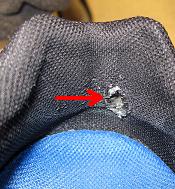
Heel bump has rubbed a hole in the back of the shoe.
How Can You Prevent Pump Bumps?
You can help prevent a recurrence of Haglund’s Deformity by avoiding shoes that press directly on the painful area on the back of the heel; using orthotics or arch supports to limit abnormal motion; use strengthening and stretching exercises to maintain strength and decrease tension in the Achilles tendon; avoid excessive running on hard surfaces and running uphill; cut out the back inside of your shoe to allow room for the bump; wear comfortable old shoes with holes worn in the back, not new shoes.
What is the Best Shoe for a Bump on the Back of the Heel
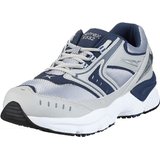
Aetrex Heel Strap
Our recommended shoes for this problem are the Aetrex Women’s Edge Heel Strap Shoes for women and the Aetrex HP Runner for men.
These shoes have two very unique features that make them very effective shoes to reduce pressure on the back of the heel.
- An adjustable strap on the back of the heel
- A lack of a plastic “heel counter” that is present in most shoes.

heel strap
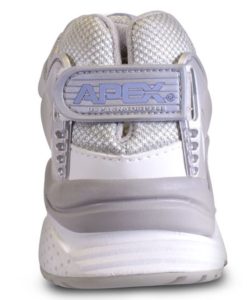
These are really very unique shoes and the only ones we have found with these features and the ability to dramatically reduce pressure on the back of the heel.
What Is Achilles Insertional Tendinitis or Tendinosis?
The Achilles tendon is the strongest and largest tendon in the body. This tendon attaches to the heel bone (calcaneus) and causes the foot to push off (plantar flex) when the calf muscles tighten. The tendon is necessary for normal walking, running, and jumping. Achilles tendinitis is an inflammation of that tendon and may be localized at the end of the tendon closest to the heel or may spread upward to affect the muscles of the calf.
What Causes Achilles Insertional Tendonitis or Tendinosis?
Common causes of this disorder are athletic and traumatic injuries and can be disabling. The majority of these injuries are due to overuse. Other factors that lead to Achilles tendonitis are improper shoe selection, inadequate stretching prior to engaging in athletics, a short Achilles tendon, direct injury to the tendon, training errors and heel bone deformity. People with feet that roll in excessively (over-pronate) are at greater risk because increased pronation puts additional stress on the tendon.
What Are the Symptoms of Achilles Insertional Tendonitis or Tendinosis?
Achilles tendinitis usually begins as a dull pain in the back of the lower leg just above the heel when pushing off the ground with the foot. With repetition, the condition rapidly gets worse until any activity requiring a push-off by the foot becomes quite painful and nearly impossible. If it is left untreated, it can develop into one of two more serious conditions – Achilles Tendinosis or Insertional Calcific Tendinitis.
How Is Achilles Insertional Tendonitis or Tendinosis Treated?
Achilles tendonitis should never be self-treated because of the potential for permanent damage to the tendon. Achilles tendonitis only gets worse with time. While you are waiting to see your doctor, you may find some using Silipos Achilles Heel Guard during the day, a night splint at night and a topical pain reliever like Orthogel Cold Therapy for temporary relief of pain. You can get these products at www.FootAnkleStore.com.
When you come in for a consultation, we will implement a treatment plan that incorporates the following three components based on the latest research and recommended therapy:
- Treating the inflammation.
- Strengthening muscles attached to the Achilles tendon using eccentric exercise.
- Shockwave Therapy to stimulate healing.
- Biomechanical control using orthotics and proper shoes.
What Is Achilles Insertional Calcific Tendinosis (AICT)?
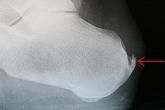
Heel Spur Back of Heel (AICT)
AICT is very similar to Achilles Instertional Tendonitis (AIT), except that there is a bone spur found on the back of the heel where the Achilles tendon attaches into the bone. Initial treatment is exactly the same as for AIT .
Shockwave Therapy may Help “Dissolve Calcific Deposits”
Several studies have shown that shockwave therapy is helpful for Achilles insertional tendonitis and may infact help to dissolve the calcific deposits in the Achilles tendon1.
AICT sometimes requires surgery as sometimes this problem just does not get better if we don’t first get rid of the bone spur. We still consider surgery the very last resort for treatment and we will do everything to help you avoid it, but it sometimes is the only effective treatment.
How is the Surgery for Achilles Insertional Calcific Tendonosis Performed?
- First, we have to separate a portion of the Achilles tendon away from the bone
- Then we remove the heel spur
- If the tendon is abnormally thickened, it may be made thinner
- An “anchor” is put through the tendon into the heel bone to hold the Achilles tendon in place while it heals.
After surgery the patient is put into a boot to protect the foot. No weightbearing can happen until after the tendon has healed back to the bone and this will usually take 4 – 6 weeks. Then there is approximately two more weeks wearing the walking boot when weightbearing is allowed. You would not be able to walk in normal shoes for eight weeks and it will be six – nine months or more before running can take place. This surgery is usually very effective, but it is definitely a hassle to recover from. If it is your right foot, you will be be driving for at least eight weeks.
What Is Retrocalcaneal Bursitis?
It is the inflammation of a small sack of fluid (a bursa) that sits between the heel bone and the Achilles tendon. Normally, the bursa acts to help the tendon glide smoothly over the bone. Sometimes, however, it can become irritated and inflamed. Also called Achilles Tendon Bursitis, Retrocalcaneal Bursitis causes pain on the back of the heel and is a common problem we see, particularly with runners. It is often mistake for and can occur simultaneously to Achilles Tendinitis.
What are the Symptoms and Causes of Retrocalcaneal Bursitis?
Common symptoms include back of the heel pain; pain when running on soft surfaces or running uphill; swelling and pain at the back of the heel; pain made worse by shoes pressing on the area; or a spongy feeling when you press your fingers on both sides of your heel. Retrocalcaneal Bursitis can be caused by overuse of the ankle, excessive running, walking or jumping, a short Achilles tendon, an enlarged heel bone, biomechanical abnormalities and training errors.
How Is Retrocalcaneal Bursitis Treated?
The correct treatment will depend on the cause. If the problem is due to an enlarged heel bone, surgery may be considered, but only as a last resort. In general, however, treatment may include:
- Rest and cold therapy or icing (but not directly onto the skin).
- Anti-inflammatory measures.
- Training and rehabilitation advice.
- Shoe changes or modifications.
- Foot orthotics or arch supports.
You can also try self-treatment measures to reduce inflammation, reduce tension on the Achilles tendon and reduce pressure on the back of the heel. Click here for a nine step plan to relieve pain on the back of the heel. You can try this for 3 weeks and then if it doesn’t work, contact us for a consultation.
Non-Surgical Treatment Goals at the Foot & Ankle Center
Our approach is to be conservative and as non-invasive as possible. We first pursue non-surgical options and, in most cases, we are very successful at relieving posterior heel pain without surgery. In fact, surgery on this area of the foot can involve long recovery times, so we make every effort to avoid it.
Some of our non-invasive treatments options for back of the heel pain include:
- Heel Lift or Shoe with a Moderate Heel: Walking in bare feet or a flat-soled shoe causes increased tightness on the Achilles tendon where it attaches into the heel. These options can help reduce the stress on the tendon and decrease irritation.
- Custom foot orthotics: Studies have shown that custom orthotics can reduce stress by limiting both tension and “twist” on the tendon. Orthotics help about 60% of patients with back of the heel pain. We will evaluate you to see if you’re a good candidate.
- Achilles Strengthening: Specific types of strengthening have been shown to be effective in treating Achilles tendonitis. If you are a candidate, we will start you on an appropriate strengthening exercise program to address your symptoms.
- Immobilization: If pain and inflammation are severe, we may help the area calm down by immobilizing it in a walking boot for a short period of time.
- Calf Stretching: Regular stretching of the calf muscles and the Achilles tendon can help the compliance and length of the Achilles tendon. This makes the tendon more resistant to wear and tear.
- Anti-inflammatory Medication: Anti-inflammatory medications can help treat swelling and pain but do not cure the underlying problem. Patients with a history of stomach problems, such as an ulcer or heartburn, should avoid these medications.
- Weight Loss: If you are carrying extra weight, losing it can alleviate your pain. Many patients with posterior heel pain are overweight. Working with a nutritionist, trainer and your doctor to lose at 5-10 pounds or more substantial weight can be the most effective way to eliminate back of the heel pain because the Achilles tendon is subject to forces equivalent to many times body weight during regular, daily activities such as walking and standing, so weight loss is critical.
Home Treatment for Back of Heel Pain
Your goal when trying to treat pain on the back of the heel is to reduce the two forces that cause pain in that region. Those forces are:
- Friction
- Pressure
The products below are the ones we recommend to our patients and they are also affiliate links so we may receive a small commission at no additional cost to you if your order from the link.
Reducing Friction at the Back of the Heel
Use orthotics or arch supports to limit foot motion. Using an arch support will stop the arch from flattening which in turn helps stop the heel from turning in. This reduces friction on the back of the heel. We recommend the following arch supports:
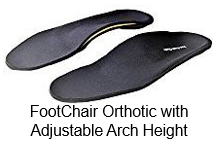
- For athletics shoes and other lace-up shoes we recommend the FootChair Podiatrist Designed Orthotic. The FootChair orthotic has a stable arch
 that is adjustable to different arch heights. This higher arch will limit foot motion which can help stop the foot from rubbing against the back of the shoe. This unique orthotic has a very supportive arch along with an adjustable arch via pads that can be inserted under the cover.
- For people with wide feet or very flat feet we recommend the PowerStep Wide Orthotic. It also has a very good arch, although it is not adjustable. The width, however, is very helpful for those with wider or flatter feet.
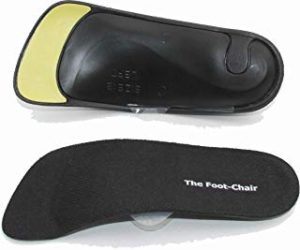
- For dress shoes and other small shoes we recommend the FootChair Slim Orthotic with adjustable arch support. Like the full-size version of the FootChair
 it has an adjustable arch but it also fits in women’s heels and flats along with with smaller sport shoes such as It has the same exceptional adjustable arch support as the full-size FootChair but with a much slimmer profile. In addition it flexes to adapt to most heel heights.
- As noted above, the the Aetrex Women’s Edge Heel Strap Shoes for women and the Aetrex HP Runner for men have an adjustable strap on the heel. They also has no plastic heel counter so they will put
 less pressure on the back of the heel compared to other shoes.

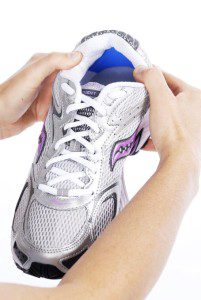
Use a medical grade teflon patch in the heel of shoe to reduce friction. These “Engo patches” stick onto the inside of the heel to reduce friction. In the picture of the shoe the Engo patch is the blue patch on the inside back portion of the heel.
Reducing Pressure at the Back of the Heel
Pressure can be reduced by using a “U”-shaped silicone pad around the bump on the back of heel. The picture shows the pad on the bottom of the foot, but it can also be used on the back of the heel. You can 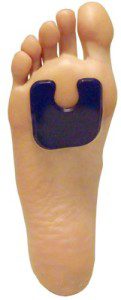 find the silicone pressure pad here.
When Surgical Intervention Is Required for Pain on the Back of the Heel
Because surgery for back of heel pain often results in a long recovery period, we try to exhaust all conservative treatment options before considering surgery. However, if all conservative treatment has failed, surgery may be indicated. Surgery for back of heel pain may involve:
- Removing the extra bone (Haglund’s Deformity) on the back of the heel.
- Removing the inflamed and thick retrocalcaneal bursa.
- “Cleaning up” the Achilles tendon where it attaches into the back of the heel. Sometimes, if the tendon is in bad shape, we must partially or completely detach the tendon and then reattach it.
- Removal of bone spur and reattachment of the Achilles tendon.
Surgery usually offers good outcomes, but has a long recovery. Initially, the leg must be immobilized to allow the surgical site to heal. Later, gentle range of motion exercises can be started. Usually there is very limited or no weight-bearing activity allowed for the first six weeks after surgery. Activity is gradually increased and significant improvement can take up to six to nine months. Surgical treatment can cause complications including increased risk of Achilles tendon rupture (very rare);infection; wound breakdown; injury to nerves; deep vein thrombosis; pulmonary embolism and prolonged healing.
If you’re struggling with pain in the back of your heel that’s painful, limits your activity and is compromising your quality of life, contact the heel pain professionals at the Foot & Ankle Center of Washington for a consultation at our convenient Seattle office to get your treatment started as soon as possible.
Medical References
- Dahmen, G. P.; et.al Die Extrakorporale Stosswellentherapie in der Orthopädie – Empfehlungen zu Indikationen und Techniken. In: Forschung und Klinik. Tübingen: Attempto Verlag, 1995.
