




Click Here For Products Used In Treatment And Prevention Of Stress Fractures
A stress fracture is a break in a bone that is caused by repetitive stress. It may occur in any bone, but is quite common in the metatarsal bones of the foot. A stress fracture usually starts as a small crack in the outer shell (the cortex) of the bone.
Without proper treatment, this may progress to fracture all the way through the bone. If you suspect that you have a stress fracture, call our office right away and tell the receptionist that you think you may have a fracture. The receptionist will try to get you an appointment right away.
Metatarsal Stress Fracture Symptoms
Metatarsal stress fractures often appear initially as simply pain over the top of the foot, sometimes – but not always – with swelling. It is usually worse after activity or during activities that require bending of the foot. They are most common in the second and third metatarsal bones. It is very common for patients to state that they have no memory of any injury.
Stress Fracture in Foot: Examination and Treatment
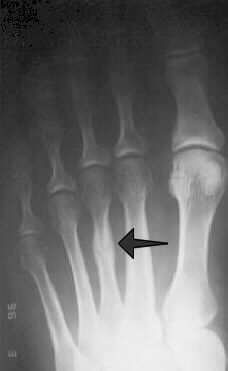
Figure 1 – Third metatarsal stress fracture
Once we examine your feet, if we feel that you may have a stress fracture we will likely take an x-ray. It should be noted that metatarsal stress fracture may not become apparent on x-rays until a few weeks after the injury. Stress fractures of the third and fifth metatarsals seen in the xrays below.
Treatment of Metatarsal Stress Fractures
If it turns out that you do likely have a stress fracture, we will immobilize your foot with a special shoe or boot. In addition we will likely use some sort of arch support to help spread weight over a larger portion of the foot. These treatments usually protect your foot so it can heal while allowing you to still bear weight on the foot. Crutches are usually not necessary except for metatarsal base fractures. A Jones fracture is the term used for a fracture approximately 1.5 cm from the base of the 5th metatarsal, Figure 2, these fractures are very difficult to heal and require a long period of non weight bearing or surgery. Bone stimulators are often suggested for a Jone’s fractures.
Self Treatment for Metatarsal Stress Fractures
Stress fractures should not be self-treated. Inappropriate treatment could lead to significantly worse problems. For example, a stress fracture that breaks all the way through could require surgery. If you absolutely can’t see a doctor right away at least try the products below until you can.
Disclosure: This page contains affiliate links, meaning we receive a commission if you decide to make a purchase through our links, but this is at no additional cost to you. Our recommendations are based on experience with and knowledge of these products, and we recommend them because they are genuinely helpful and useful, not because of the small commissions we may receive. Please don’t spend any money on these products unless you believe they will help you achieve your goals.
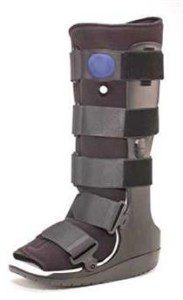
Wear a Walking Boot
Until you can get in to see a doctor wear a walking boot. You can borrow one or buy one online. This fracture walking boot is a quality boot at a good price.
Use an Arch Support
Wear a firm arch support in the boot to distribute force over entire bottom of the foot and off of the metatarsal heads. We 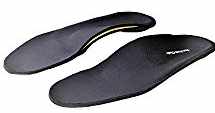 recommend the FootChair Podiatrist Designed Orthotic. It has one of the best arch supports on the market and is very unique in that the arch height can be adjusted via pads that are inserted under the cover. This allows for a very customized fit and better protection for the metatarsals.
When our patients have moved out of boot back into their regular shoes we have them continue to wear arch supports for at least 3 months following the injury.
For athletic and walking shoes we most often recommend the FootChair Orthotics mentioned above
For high heels, flats, other dress shoes and soccer cleats (and other smaller shoes) we recommend the FootChair Slim Orthotic with adjustable arch support. It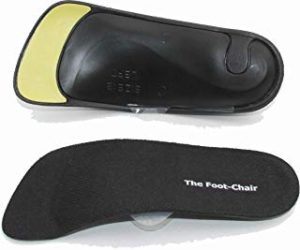 offers great support for various arch heights and fits in all of the smaller shoes the full-size orthotics do not fit in (even high heels). It has the same exceptional adjustable arch support as the full-size FootChair but with a much slimmer profile. In addition it flexes to adapt to most heel heights.
Use Crutches or Cane Until You have a Definitive Diagnosis
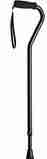
If you suspect a fracture of your foot its also a good idea to use crutches until you can have your foot examined and x-rayed. At the very least use a cane to reduce weight bearing on the injured foot.
Use a Shoe Balancer to Keep Yourself Even When Wearing a Boot
If you physically cannot use crutches then it can also help to use an Even-up Shoe Balancer on the bottom of the shoe on your other foot. This will help keep you 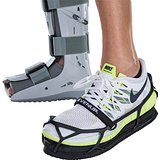 even which will reduce pressure on the injured foot while also helping to prevent knee, hip and back pain that might result from being uneven.
Consider a Vitamin D Supplement
There is fairly good evidence (although not conclusive) that low Vitamin D levels may contribute to increasing stress  fracture risk and slow healing of fractures. The evidence is strong enough that we recommend that our patients with stress fractures take a Vitamin D supplement. We like NatureMade Vitamin D3 2000 iu as it is a respected brand at a good price. We usually start our patients at 1 per day and then will check their Vitamin D levels.
We recommend that anyone who suspects they may have a stress fracture talk to their doctors about whether Vitamin D supplementation might be good for them.
What Causes Stress Fractures?
There are a number of causes, but common ones include:
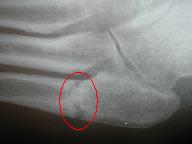
Figure 2- Fifth Metatarsal Stress Fracture “Jone’s Fracture”
- Decreased density of the bones (e.g.. osteoporosis)
- Unusual stress on a metatarsal due to mal-position or another forefoot deformity (e.g.. bunion)
- Abnormal foot structure or mechanics (e.g.. flatfoot)
- Increased levels of activity, especially without proper conditioning
- Obesity
- Unstable shoes
- Excessive stress (such as running a marathon)
Metatarsal Stress Reactions – The Stress Fracture That Never Shows on X-ray
Sometimes a patient will have all the symptoms of a stress fracture including pain right on a metatarsal bone and swelling on top of the foot but no fracture ever shows up on x-ray. This is often due to a condition called a stress reaction. Stress reactions are simply the precursor to an stress fracture where there is weakening of the inside of the bone but it never quite breaks through. Stress reactions will not show up on x-ray but do show up on MRI or bone scans. Diagnosis of stress reactions is very straightforward, however, and these tests are rarely necessary.
Which Metatarsals Tend to Have the Most Stress Fractures?
The most common stress fractures are of the 2nd. This is for several reasons:
1. It is next to the first metatarsal which is biggest of the metatarsals and the one that should take up the most force. But in some foot types the first metatarsal is allowed to move out of the way when force is applied to the bottom of it. That leaves the much thinner and weaker 2nd metatarsal to take up that extra weight resulting in more potential for fracture.
2. The 2nd is the longest of the metatarsal bones. This causes it to have more force applied to it.
3. At it’s base, the 2nd metatarsal is locked into place preventing it from moving when force is applied to it from the bottom. Again this increases force on this bone and makes it more susceptible to injury.
After the 2nd, the 3rd and 4th are the most common metatarsal bones to have stress fractures. The 1st and 5th metatarsals are thicker and more robust and less likely to be injured.
How are Stress Fractures Prevented?
Since stress fractures are usually caused by too much pressure on the metatarsal bone, we want to reduce pressure on that bone to prevent the stress fracture from occurring again. We can do this best with the use of custom orthotics that are prescribed specifically to reduce pressure on the injured portion of the foot. We prescribe the orthotics in a manner that acts to transfer the force off of the at-risk metatarsal and redistribute that force to other parts of the foot. Wearing the proper shoes is also critical and we will help you in finding the correct shoes for your feet.
How Should Orthotics Be Made to Prevent Stress Fractures?
Orthotics in this situation have one primary goal and that is to reduce force through the metatarsal bone that is at risk of stress fracture or has previously had a stress fracture. How we make this orthotic will depend on your foot type and the underlying cause of the excessive force in the metatarsal bone. For example, if your foot is rolling in excessively and that is causing the first metatarsal bone to be pushed up, we need to design the orthotic to prevent this so that the first metatarsal bone continues to bear weight in order to reduce pressure on the 2nd. In addition the orthotics should contour very close to the arch of the foot so that it can transfer pressure off of the ball of the foot (the metatarsal heads) and onto the arch of the foot.
Sometimes a prefabricated orthotic can accomplish this and sometimes a custom orthotic is necessary. Our favorite 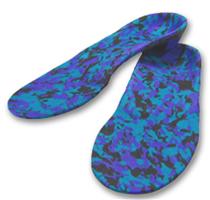 prefabricated orthotic to prevent stress fractures is the PowerStep Full-length Orthotic because it has a higher than average arch for a prefabricated device and thus does a good job of transferring force off of the metatarsal heads.
Custom orthotics tend to work even better at preventing stress fractures because they take even more pressure off of the metatarsal heads.
If you think you may have a stress fracture, or you have previously had one and want to prevent recurrence, contact us for an appointment in our convenient Seattle office.
