




Have you received custom orthotics for treatment of plantar fasciitis and found that they did not relieve your pain? Many people have. Recent research on orthotics and plantar fasciitis has shown how orthotics should be prescribed to best treat plantar fasciitis and why many orthotics do not control plantar fasciitis pain / heel pain as well as they should.
Video: What are the Best Orthotics for Heel Pain?
How Must Orthotics Be Made to Relieve Plantar Fasciitis?
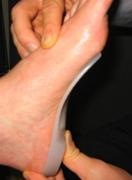
Figure 1 – Tight fitting orthotic.
Let’s first look at the cause of plantar fasciitis. In simple terms it is due to the foot flattening out too much. As can be seen in the picture on the right, when the foot flattens, the foot gets longer and this stretches the plantar fascia. This stretch is what causes the damage to the tissue and pain at the heel and arch.
Orthotics Must Decrease Tension on the Plantar Fascia
In order to best control plantar fascia pain, an orthotic must work to decrease tension on the plantar fascia. To decrease tension on the plantar fascia, it must stop the foot from getting flatter and longer. To do that the orthotic must conform very close to the arch of the foot, figure 1.
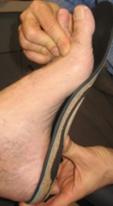
Figure 2 – Loose fitting orthotic
Why Do Many Orthotics Fail to Relieve Plantar Fascia Pain?
This is where most plantar fasciitis orthotics fail in reducing tension on the plantar fascia, they simply do not conform close enough to the arch of the foot. Take a look at figure 1 and note how close the arch conforms to the foot. Now look at figure 2 and see how the orthotic gaps from the arch. This lower arch lets the foot flatten and lengthen and increases tension on the plantar fascia. Only orthotics that conform very close to your arch are able to effectively reduce plantar fascial tension. These are called “total contact orthotics”.
Research on Orthotics for Heel Pain / Plantar Fasciitis
The importance of total contact orthotics has been demonstrated in several well done studies. In particular, a 1996 study by GF Kogler tested a series of five different orthotics by placing them under cadaver feet and then applying a load to the foot, Figure 3. A strain gauge was put into the plantar fascia to measure how much tension was relieved by each type of orthotic. Kogler’s experimental apparatus is shown at right. Kogler showed definitively that orthotics that conformed closely to the arch of the foot (higher arched orthotics) best decreased tension in the plantar fascia. In fact, two of the lower arched orthotics actually increased tension in the plantar fascia.
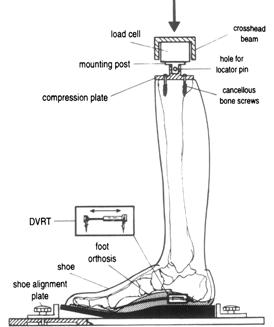
Figure 3 – Orthotic study using strain gauges.
If you need orthotics for plantar fasciitis, you want to be absolutely sure that they are made correctly and conform almost air tight to your arch.
Keys to Making Proper Plantar Fasciitis Orthotics:
- A non-weightbearing cast or laser scan of the foot should be done. Weightbearing casts (often using foam boxes) and walking across a scanner have been shown in several studies to be ineffective methods to make an orthotic used to treat plantar fasciitis 1-5.
- The doctor must place your foot in the correct position when casting. Casting can be done with plaster or a laser scan. It is vitally important that the podiatrist him/herself takes the cast of your foot. Proper casting is key, if the doctor has a medical assistant do their casting, go somewhere else. Proper casting is critical to a good outcome and takes a long time to learn to do properly.
- The doctor must write a prescription that directs the lab to make the orthotic in a way that conforms tightly to the arch of your foot in order to reduce plantar fascial tension. If your doctor’s prescription does not say this specifically, the orthotic will not likely match the foot very well.
- The doctor must choose to have your orthotics made by a very high quality orthotic lab. Unfortunately, there is a lot of variance in the quality of labs and the quality of orthotics that they make. Many labs make orthotics with a lower arch then they should have in order to prevent any possibility of the patient complaining about the orthotic irritating their arch. Arch irritation does sometimes occur with total contact orthotics, but a good podiatrist will be able to correct that with a simple adjustment. If they can’t, you need to find a different podiatrist.
Does everyone with plantar fasciitis or heel spurs need custom orthotics?
Absolutely not. But if you have had repeated episodes of plantar fasciitis, have had it for more than 6 months, have tried other treatments without success or simply have bad foot mechanics, you will probably need custom orthotics for complete and long-term relief. But if you don’t fit in these categories, you may do fine with a prefabricated orthotic and often that is what we first recommend. Like custom orthotics, prefabricated ones work best for heel pain if they have a higher arch profile. We list the best prefabricated orthotics and other home treatments for plantar fasciitis here.
Why Are So Many Plantar Fasciitis Orthotics Not Made Correctly?
Sadly, orthotic therapy is not as well regulated as it should be. Many practitioners who provide orthotics are not well trained in orthotic therapy and many who were once well trained have not kept abreast of the latest research.
Why do Custom Orthotics Work Better than OTC Arch Supports for Plantar Fasciitis?
Many patients with heel pain respond well to OTC orthotics. They are often an inexpensive way to start treatment. In fact, we often recommend over-the-counter plantar fasciitis arch supports for treatment of heel pain. OTC, however, will not work as well as custom orthotics (if the custom ones are made correctly) at decreasing tension on the plantar fascia because they do not conform as close to the arch of the foot.
What are the Best OTC Plantar Fasciitis Arch Supports?
Not everyone with plantar fasciitis needs a custom orthotic. Some people do very well with a less expensive over-the-counter arch support. The biomechanics are the same whether using custom orthotics or OTC arch supports to treat plantar fasciitis. So when we recommend arch supports for heel pain patients, we look for insoles that have a higher arch that will best decrease tension on the plantar fascia.
The products below are the ones we recommend to our patients and they are also affiliate links so we may receive a small commission at no additional cost to you if your order from the link.
The best we have found is the FootChair Podiatrist Designed Adjustable Arch Orthotic. We recommend this model over others
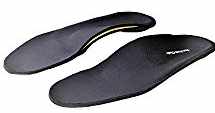
FootChair Adjustable Arch Orthotic
due to the adjustable arch via pads that can be inserted under the cover and the overall stability. We also find it easy to adjust. After reviewing many arch supports, we find this the best full size arch support for plantar fasciitis.
OTC Orthotic for High Heels, Flats and Soccer Cleats
If you need a prefabricated arch support for smaller shoes, including high heels, flats, soccer cleats, bicycle shoes or other smaller shoes 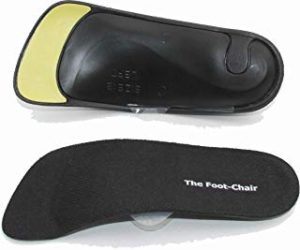 then we recommend the FootChair Slim Orthotic with adjustable arch support. It’s the most effective OTC arch support we have found to fit in women’s heels and flats and other smaller shoes. It has the same exceptional adjustable arch support as the full-size FootChair but with a much slimmer profile. In addition it flexes to adapt to most heel heights.
References
- Bordelon RL: Subcalcaneal pain. Clin Orthop 177:49, 1983
- Capon, N, Higgs, ER, Dieppe, PA, et al: Arthritis in Behcet’s syndrome. Br J Radiol 56:87,1983
- Cheung JT et al: Effect of Achilles tendon loading on plantar fascia tension in the standing foot. Clinical Biomechanics (Bristol, Avon) 21(2):194-203, 2006
- Digiovanni BF, et al: Plantar fascia specific stretching exercise improves outcomes in patients with chronic plantar fasciitis. A prospective clinical trial with two-year follow-up: J Bone Joint Surg 88A:1775-81, 2006
- Harty J: The role of hamstring tightness in plantar fasciitis: Foot Ankle Int 26(12) 1089-92, 2005
