




What are Plantar (Foot) Warts?
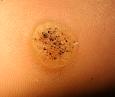
Wart – central black dots, blood vessels, called rete pegs.
Warts are one of a number of soft tissue conditions of the foot that can be quite painful. They are caused by a virus, which invades the skin through small or invisible cuts and abrasions. They can appear anywhere on the skin, but only those on the bottom of the foot are called plantar warts.
Children, especially teenagers, tend to be more susceptible to warts than adults; some people are immune to warts.
Treatment of Plantar Warts
We have a number of treatments available for warts and because they can be resistant to treatment we review the literature regularly for articles pertaining to better wart treatments.
Our standard treatments include:
Topical Treatment of Warts – Painless and Effective
Most over-the-counter wart medications are not effective for warts on the bottom of the foot because while they will get rid of some of the wart they do not kill the virus so the wart keeps growing.
We commonalty prescribe a topical prescription medication called Efudex (5-flourouracil) that acts to kill the virus. This is combined with a topical acid. Most studies on this combination of medications show about a 80% success rate at getting rid of warts.
We like this as a primary treatment for most patients because it is effective and completely painless. The only downside is that it takes about 8 weeks to see complete resolution of the wart(s). Efudex has been shown to be safe for children. It is not approved for pregnant women.
Laser Treatment of Warts
We can also perform laser treatment of warts. The advantage of laser treatment is that it is a very fast way to treat the wart. The laser acts to cauterize the vessels in the wart depriving it of it’s blood supply. The downside is that it is briefly painful.
Vitamin D Injection for Warts
A newer treatment is injection of Vitamin D into the wart. Current studies show this to be about 80% effective.
Other Treatments
There are a number of other treatments available including Bleomycin injection and microwave therapy . Unfortunately, there is no one best treatment and what works for one person may not work for another.
Surgical Excision of Warts
If only a one wart is present, removal of warts by a simple surgical procedure, performed under local anesthetic, may be indicated. This is not a first line treatment as a potential complication is a scar on the bottom of the foot that can be both painful and more difficult to treat than the wart.
Self -Treatment of Plantar Warts
The products that are recommended below are those that we recommend to our patients, and they are also affiliate links so we may receive a small commission at no additional cost to you if your order from the link.
We advise against self-treatment of warts. Over-the-counter medications contain acids or chemicals that destroy skin cells, and can damage healthy tissue in the surrounding area.
Self-treatment with such medications should always be avoided by people with diabetes and those with cardiovascular or circulatory disorders. Never use them in the presence of an active infection.
If you absolutely cannot see a podiatrist for treatment of plantar warts and 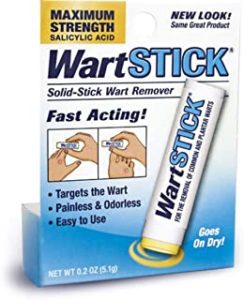 you want to try self-treatment, salacylic acid has been shown to be the most effective over-the-counter wart medication. We recommend the WartStick for two reasons:
- It is one of the strongest OTC wart medications with 40% salacylic acid.
- It goes on dry so it is less likely to spread to and damage surrounding tissue.
Try this for about 3-4 weeks. If you are not seeing improvement see a podiatrist or dermatologist.
Is That Really a Wart?
On your first visit we will evaluate your foot to determine if the lesion on your foot is a wart and we will discuss various treatments with you – including the advantages and disadvantages of each. If topical treatment is to be used then you will receive a prescription. If surgical removal is indicated, we will make you an appointment to return soon to have that done. A complete evaluation is necessary before surgical excision can be scheduled, so we usually cannot remove the warts on your first visit. To get started on treating your foot warts contact us today to make an appointment in our Seattle office.
Identification of Warts
Most warts are harmless, even though they cause pain. They are easily mistaken for calluses—which are layers of dead skin that build up in areas that are being irritated by excessive pressure or friction. Warts, however, are a viral infection.
It is also possible for a wart to be mistaken for more serious lesions, including malignant lesions. These problems are very rare, but is wise to consult a podiatric physician when any suspicious growth or is noted on the skin of the foot in order to ensure a proper diagnosis.
Plantar warts tend to be flat and hard, with a rough surface and well-defined boundaries; warts are generally raised and fleshier when they appear on the top of the foot or on the toes. Plantar warts are often gray or brown (but the color may vary), with a center that appears as one or more pinpoints of black. Warts can be frustrating in that they are often very resistant to treatment and have a propensity to reoccur.
Source of the Wart Virus
The plantar wart is often contracted by walking barefoot on ground where the virus is hiding. The virus lives best in moist, warm environments, making infection a common occurrence in places such as gyms.
If left untreated, warts can grow to more than an inch and can spread into clusters. Like any other infectious lesion, plantar warts are spread by scratching, touching, or even by contact with skin shed from another wart. The wart may also bleed, another route for spreading.
Occasionally, warts will simply disappear, and, just as frequently, they can recur in the same location.
The pain from a wart is caused by increased pressure on weight bearing areas – such as the heel or the ball of the foot.
Prevention Tips
- Avoid going barefoot, except on sandy beaches.
- Change your socks and shoes daily.
- Keep your feet clean and dry.
- Check kid’s feet for lesions.
- Avoid direct contact with warts—from other persons or from other parts of the body.
- Visit your podiatrist as part of your annual health checkup.
Tips for Individuals with Warts
- Avoid self-treatment with over-the-counter preparations if possible.
- Seek professional podiatric evaluation and assistance with the treatment of your warts.
- Diabetics and other patients with circulatory, immunological, or neurological problems should be especially careful with the treatment of their warts.
- Warts may spread and are catching. Make sure you have your warts evaluated to protect yourself and those close to you.
