




Have Severe or Chronic Heel Pain? We Can Help
At the Seattle Heel Pain Center, we treat many causes of heel pain. A number of conditions can cause chronic or severe heel pain. If your heel pain is not getting better with standard treatments, or is severe in nature, we want to see you right away because there are some serious problems that can lead to extreme heel pain. If your pain is chronic or severe, let us know when you contact us for an appointment and we will try to get you in right away.
Video: Causes and Treatment of Chronic Plantar Fasciitis
What Are the Causes of Severe Heel Pain?
The most common cause of heel pain is plantar fasciitis, and for some people plantar fasciitis can cause really intense pain in the heel. There are, however, more serious problems that can lead to even worse heel pain and should be evaluated and treated right away. Listed below are some uncommon, but potentially serious, causes of severe heel pain that need immediate treatment:
- Fracture of the heel bone (calcaneus fracture)
- Infection
- Foreign body
- Bone cyst
- Subtalar joint arthritis
What Causes Persistent Heel Pain?
Untreated heel pain can linger indefinitely. But if you’ve had treatment and your heel pain is persistent and still doesn’t improve, the cause is likely:
- Wrong diagnosis and/or
- Wrong treatment and/or
- Plantar fasciosis
The Wrong Diagnosis for Your Heel Pain Can Leave You Hurting
Although plantar fasciitis is the most common cause of heel pain, it is not the cause of all heel pain. If you’ve been diagnosed with plantar fasciitis, yet it’s not getting better, you may not have plantar fasciitis at all. In order to get you the best treatment that leads to meaningful pain relief, you need a proper diagnosis. Come to the Seattle Heel Pain Center to get an accurate diagnosis and the appropriate treatment to address your heel pain. If you don’t have plantar fasciitis, your heel pain could be caused by:
- Nerve entrapment
- Tarsal tunnel syndrome
- Sciatica
- Plantar fascial rupture
- Calcaneal stress fracture
- Rheumatoid arthritis and other medical conditions
- Heel pain in kids may be caused by calcaneal apophysitis
The Wrong Treatment for Your Heel Pain Can Leave You with Pain
Even if you had an accurate diagnosis for your severe or chronic heel pain, it’s possible that you simply did not receive proper treatment for your condition. There are many treatments for plantar fasciitis and other causes of heel pain, some more effective than others. You want a podiatrist that stays current on research and developments in heel pain therapy.
An example of an incorrect treatment that we often see is patients who have been given orthotics that were not made correctly to treat plantar fasciitis. Read here how orthotics for plantar fasciitis should be made. After ensuring the cause of your heel pain is accurately diagnosed, we will review your entire treatment plan to ensure you receive the proper treatment and experience the best possible pain relief.
Plantar Fasciosis – The Most Common Cause of Heel Pain That Won’t Get Better
Sometimes chronic heel pain is due to a condition called plantar fasciosis rather than plantar fasciitis. These conditions both cause heel pain, but are different. Fasciitis is an inflammatory disorder while fasciosis is a degenerative disorder. Plantar fasciosis is a thickening or scarring of the plantar fascia that occurs due to long term inflammation of the plantar fascia that causes degeneration.
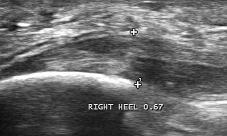
Illustration 1: Ultrasound of heel showing thick plantar fascia (looking at foot upside down with toes towards the right. Solid curved white line is the heel bone, bottom up. Plantar Fascia between the + marks).
Diagnosis of Plantar Fasciosis
We often diagnose plantar fasciosis using ultrasound imaging. A normal plantar fascia is about 4mm thick where it attaches into the heel bone. If plantar fasciosis is present, it may be 6 or 7mm, or even thicker. See figure 1. If plantar fasciitis has been present for a long time, the fascia can be scarred and resistant to treatment.
Check out the advanced therapies below that we may recommend if you have plantar fasciosis or other chronic or severe heel pain.
Treatment of Plantar Fasciosis
Standard treatments for plantar fasciitis tend not to be as effective for plantar fasciosis. Newer treatments for plantar fasciosis are focused on purposely inducing trauma to the plantar fascia. This causes minor bleeding within the fascia which acts to stimulate the healing process of the tissue. Blood, oxygen and healing proteins rush to the site, causing a metabolic process that induces healing by the formation of new connective tissue.
Shockwave therapy is the most effective method to stimulate healing of plantar fasciosis. Another options is procedure called “dry needling“. Read more about these two below.
Advanced Therapies for Severe or Chronic Heel Pain
Sometimes plantar fasciitis and other causes of heel pain do not respond to standard treatments. If this is your situation, don’t worry. In the case of stubborn heel pain that just won’t go away there are a number of advanced therapies that can relieve your pain.
We can almost always help even if you have been to several other doctors and not found relief. The number of therapies available for heel pain can be confusing. There are advantages and disadvantages to each but when you come in for your consultation, we’ll explain your options fully and tell you which will likely give you the most significant pain relief.
Here are some advanced therapies for heel pain that we may recommend:
- Plantar Fasciitis Orthotics
- Shockwave therapy
- Ultrasound Guided Steroid Injections
- Dry Needling
- Radiofrequency Ablation
- Surgery (only as a very last resort)
Plantar Fasciitis Orthotics
A number of studies support the use of foot orthotics to treat heel pain, particularly heel pain caused by plantar fasciitis These studies also show that orthotics must be prescribed in a very specific manner to be most effective for heel pain. Read here how orthotics should be made to treat heel pain.
Ultrasound Guided Steroid Injections
Steroid injections are a common and well proven treatment to rapidly reduce pain and inflammation associated with plantar fasciitis. For more chronic cases of heel pain, we often administer these injections using ultrasound guidance. This means that we use ultrasound imaging so we can most accurately place the injection to improve outcomes. Read more about ultrasound guided injections.
Extracorporeal Shockwave Therapy
This therapy uses high powered shockwaves to treat heel pain. It is a non-invasive, non-surgical treatment option for heel pain associated with stubborn plantar fasciitis or fasciosis. Shockwaves work by stimulating the healing process and promoting blood flow to the injured area. There have been many studies done showing the effectiveness of shockwave and it is considered a very effective treatment for plantar fasciosis. Read more on shockwave therapy.
Dry Needling
This new treatment that shows promising results has a terrible name, but is actually not a painful procedure.
It is a quick, minimally invasive and inexpensive technique that was developed at the Department of Experimental Medicine at the University of Genoa, Italy. In a study published in 2008, researchers achieved a 95 percent success rate in completely resolving plantar fasciitis symptoms. Newer studies have shown about 70% improvement. While a promising treatment, there is much more evidence for the use of shockwave therapy in treating plantar fasciitis. Read more about dry needling therapy.
Radiofrequency Nerve Ablation (RFNA)
At the Seattle Heel Pain Center we are always evaluating new treatments for chronic heel pain. One of the newer ones is a process called Radiofrequency Nerve Ablation. It is a minimally invasive procedure used to treat the pain associated with chronic heel pain and other nerve conditions. This procedure does not treat plantar fasciitis or plantar fasciosis, but acts to block the nerve signal that causes the pain. Essentially, the idea is to deaden the nerve that carries the pain associated with plantar fasciitis.
In RFNA, the heel is numbed with a local anesthetic and then an electrode is used to electrically disrupt the nerve. Adjacent tissue is not damaged and the patient can walk out of the office immediately. A 2009 study showed positive results, but one study is not enough evidence for us to recommend this treatment when other established treatments are known to offer effect relief for heel pain. We will update this page as more information becomes available.
To learn more about Radiofrequency Ablation, here is the summary of the 2009 study.
A study involving 22 patients (31 feet) with a history of chronic heel pain associated with plantar fasciitis were examined to determine if ablation of the sensory branch of the medial calcaneal nerve would result in symptomatic relief. Participants in this study were given subjective questionnaires and visual analog scales in order to rate their symptoms before and after nerve ablation using radiofrequency energy. The results showed that the mean pre-intervention visual analog pain score was 8.12+/- 1.61 (with 10 being the worst pain the patient could imagine), and this dropped to 3.26 +/- 1.97 after 1 week and 1.46+/- 1.76 after 1 month, 1.96+/- 1.98 at 3 months. Furthermore, patients followed for up to 1 year showed no significant worsening of symptoms. Adverse events were limited to hematoma at the site of the entry of the radiofrequency cannula. These findings support the conclusion that radiofrequency nerve ablation be considered an alternative to repetitive corticosteroid injections or open surgical intervention for the treatment of recalcitrant plantar heel pain. (from: A Retrospective Analysis of 22 Patients Treated with Percutaneous Radiofrequency Nerve Ablation for Prolonged Moderate to Severe Heel Pain Associated with Plantar Fasciitis. Liden B, Simmons M, Landsman AS. Journal of Foot & Ankle Surgery, 2009)
Surgery for Chronic Plantar Fasciitis
Surgery should be considered only as a very last resort. In fact, it is only in very rare situations where all other treatments have failed that we consider surgical options. In the event, however, that every other treatment has failed, which is rare but does occur, there are surgical options. In the standard surgery for chronic plantar fasciosis, a portion of the plantar fascia is released from the heel bone. Overall the success rate is good, but because every surgery has risk that the more conservative treatments do not, we still recommend it only as a last resort.
Treatments We Do Not Currently Recommend for Plantar Fasciiits
The therapies listed above that we recommend have been shown both in our practice and in research studies to be effective. Shockwave therapy in particular has many studies that show it’s effectiveness.
There are other treatments for plantar fasciitis, fasciosis and other causes of severe and chronic heel pain that we do not currently recommend as we have not seen adequate studies to support their use. These include:
- Topaz Coblation
- Cryosurgery
- Platelet Rich Plasma (PRP) Therapy
Topaz Coblation Radiofrequency and/or Cryosurgery
These two procedures that have been promoted over the past few years for treatment of chronic plantar fasciitis. Currently, however, there are no strong studies indicating that they are effective for the treatment of plantar fasciitis. The companies advertising these procedures state that they work like dry needling and shock wave therapy in that they act to cause trauma to the plantar fascia in order to stimulate healing. However, they are considered more aggressive because they require an incision.
Although our doctors have the skill to perform these procedures, our opinion is that there is not yet enough evidence that these treatments are more effective than more established and less radical and invasive treatments. Most of the studies on these techniques currently come from those with a financial incentive to promote these treatments. If new research indicates better outcomes for these procedures, we will update this page.
Platelet Rich Plasma (PRP) Therapy
This treatment for plantar fasciitis uses blood drawn from the patient. The blood is put into a centrifuge and then spun down to separate the platelets. The platelets are then injected into the damaged tissue of the plantar fascia or Achilles tendon. Proponents of PRP claim that the platelets contain proteins that stimulate healing of the damaged plantar fascia. We have been unable to find any studies or other evidence that PRP is effective in treatment of plantar fasciitis.
In fact, studies demonstrate that cortisone injections are more effective. Studies on PRP show conflicting results – some show good outcomes while others show it as no more effective than a placebo and does not appear to reduce pain or increase activity. We will keep an eye on the literature and, if we see new information, we will post it here.
For now, we do not believe PRP is a viable treatment for our patients. Although we can offer this procedure to our patients, there is very limited evidence that it is effective and we do not recommend it. We occasionally refer patients to an interventional radiologist for PRP in cases of Achilles tendonitis that have not responded to other treatments, but not for plantar fasciitis.
If you are suffering chronic or severe heel pain, make an appointment today to see Dr. Huppin or Dr. Hale at the Seattle Heel Pain Clinic. Both doctors are heel pain specialists. If you can’t visit us, try our heel pain self treatment plan for a few weeks. If this doesn’t help, look for a podiatrist in your area who specializes in heel pain.
Medical Literature on Chronic Heel Pain
- H Lemont, KM Ammiratti, N Usen, “Plantar fasciitis: a degenerative process (fasciosis) without inflammation,” Journal of the American Podiatric Medical Association, 93(3) (2003): 234-237.
- MA Noerdlinger, PD Fadale, “The role of injectable corticosteroids in orthopedics,” Orthopedics, 24(4) (2001): 400-405.
- TG Lee, TS Ahmad, “Intralesional autologous blood injection compared to corticosteroid injection for treatment of chronic plantar fasciitis: a prospective, randomized controlled trial,” Foot & Ankle International, 28 (2007): 984-989.
- DS Malay, MM Pressman, A Assili, et al, “Extracorporeal shockwave therapy versus placebo for the treatment of chronic proximal plantar fasciitis: results of a randomized, placebo-controlled, double-blinded multicenter intervention trial,” Journal of Foot and Ankle Surgery, 45(4) (2006): 196-210.
- BH Allen, LM Fallat, S Schwartz, “Cryosurgery: an innovative technique for the treatment of plantar fasciitis,” Journal of Foot and Ankle Surgery, 46(2) (2007): 75-79.
- N Takahashi, JP Tasto, et al, “Pain relief through an antinociceptive effect after radiofrequency application,” American Journal of Sports Medicine, 35(5) (2007): 805-10.
- R Bazaz, RD Ferkel, “Results of endoscopic plantar fascia release,” Foot & Ankle International, 28 (2007): 549-555.
