




Guide to Ball of Foot Pain
What is Metatarsalgia due to Capsulitis?
Metatarsalgia is a general term used to denote pain under the ball-of-the-foot. (the area just before the toes) This is a very common problem and one of the top three complaints we treat.
Metatarsalgia (ball-of-foot-pain) is often located under the 2nd, 3rd, and 4th metatarsal heads, or more isolated at the first metatarsal head (near the big toe). Metatarsalgia usually responds very quickly to proper treatment. It can almost always be treated conservatively and surgery is rarely necessary.
Dr. Hale and Dr. Huppin are experts at treating metatarsalgia, so don’t live with your pain any longer. Contact us today to make an appointment in our Seattle clinic.
Capsulitis is the Most Common Type of Metatarsalgia
The most common type of metatarsalgia is a condition called “capsulitis of the metatarsophalangeal joint” (joint connecting toes to the forefoot).
A “joint capsule” is essentially all of the ligaments that hold two bones together. If the joint capsule is exposed to too much pressure (in other words you are pounding on it too much) it can can become inflamed. This inflammation is called a “capsulitis”.
Capsulitis of the ball of the foot is one of the top complaints we treat and usually responds to proper conservative treatment. Treatment is focused on decreasing pressure off the painful area allowing it to heal. Custom or prefabricated orthotics, and specific socks or shoes may help relieve the pressure.
Other Causes of Ball of Foot Pain
Other causes of ball of foot pain include Morton’s neuroma, calluses, fractures and arthritis. Learn about other causes of ball of foot pain here.
Treatment Goals for Capsulitis / Metatarsalgia
There are two main treatment goals when treating capsulitis
- Reduce pressure under the painful portion of the ball of the foot. We can’t emphasize this enough. If you don’t reduce the pressure on the painful area then it will likely not get better.
- Reduce the inflammation
- Stimulate healing
You can find detailed information on both professional and home treatment options below.
Dr. Hale and Dr. Huppin are experts at treating metatarsalgia, so don’t live with your pain any longer. Contact us today to make an appointment in our Seattle clinic.
Causes of Metatarsalgia Due to Capsulitis
Because most metatarsalgia is caused by excess pressure on the ball of the foot, we must find the cause of the pressure to properly treat this condition. Several conditions cause this increased pressure. These include:
- Bunions
- Short metatarsal bones
- Hammer toes
- High arched feet,
- Arthritis, stress fractures
- Bunion surgery
Onset is usually gradual as it takes a while to add up into an injury. However, it may arise suddenly if there is trauma to the area or if new shoes are involved. Sudden trauma might include landing hard on the ball of the foot while barefoot or while wearing non-cushioned shoes or stepping on a stone while running.
First Goal of Treatment: Reduce Pressure on the Painful Metatarsals
Our primary goal when treating metatarsalgia is to reduce pressure on the painful area of foot. This can be accomplished with:
Custom Orthotics and Metatarsalgia
Orthotics Should Conform Very Close to the Arch of the Foot to Treat Metatarsalgia

Custom orthotics, if properly prescribed and fitted, can relieve the symptoms of metatarsalgia.
Orthotics for metatarsalgia are prescribed specifically to help take weight off of the painful area of the foot. We prescribe an orthotic that “hugs” the arch of your foot very closely in order to transfer force off of the metatarsal heads and onto the arch. These are called “Total Contact Foot Orthotics” – and function much better than typical orthotics at reducing pressure under the ball of the foot.1-6

The pressure scans below show the effect of a total contact orthotic on forefoot pressure.
In addition, many studies show that modifications such as metatarsal pads and cushioning can further reduce pressure under the painful area of the foot. Depending on your exact condition, we will likely incorporate several modifications into your orthotics.7-10
Prefabricated Orthotics for Metatarsalgia
Although not as effective at decreasing pressure, some patients may achieve pain relief with high-quality over-the-counter arch supports. We recommend the following over-the-counter inserts most commonly for metatarsalgia. The products below are the ones we recommend to our patients and they are also affiliate links so we may receive a small commission at no additional cost to you if your order from the link.
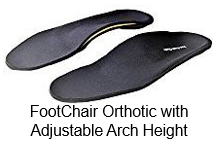
The best OTC arch support for athletic and walking shoes is the FootChair Medical Grade Orthotic with adjustable arch height. With one of the highest arches of any OTC arch support, it does an exceptional job of transferring pressure off of the ball of the foot.
FootChair also has a unique adjustable arch height. It includes pads that can be added into a pocket under the cover to allow the arch height to be increased. This is especially important for those suffering with pain under the ball of the foot. It also has cushioning for the metatarsal heads.
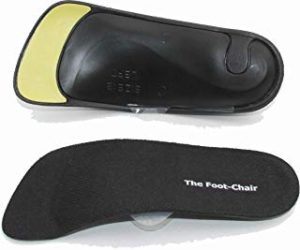
The recommended OTC arch support for womens’ dress shoes is the FootChair Slim Orthotic with adjustable arch support. It’s the only effective OTC arch support we have found to fit in women’s heels and flats. It has the same exceptional adjustable arch support as the full-size FootChair but with a much slimmer profile. In addition it flexes to adapt to most heel heights.
The FootChair Slim is also our recommended orthotic for small sport shoes such as soccer cleats.
Home Treatment Plan
You can find our 2 week home treatment plan for ball of foot pain here.
Try these suggestions for 2 week. If you don’t have relief by then, see a podiatrist.
Reduce Inflammation
Once we have reduced the pressure on the ball-of-the-foot, then we will work with you to decrease the inflammation. This could mean one or more of several treatments, including:
- Ice
- Medication
- Rest
- Physical therapy
- Injection
Stimulate Healing: Shockwave Therapy
The next treatment, particularly if you do not see rapid improvement with pressure and inflammation reduction, is to help the tissue of the capsule heal.
Shockwave therapy is a treatment that stimulates healing by two methods:
- Neo-vascularisation: Shockwave therapy helps create new blood vessels locally. The improved blood flow helps tissue heal.
- Release of growth factors: Growth factors are proteins that stimulate the cells that repair tissue
Shockwave has numerous high level studies that demonstrate it’s effectiveness in helping to heal ligamentous tissue such as the metatarsal joint capsule. For example a 2016 placebo=controlled study showed significant clinical and statistical improvements in all outcome measures in the group that received radial shockwave. It has also shown positive results in many other orthopedic conditions such as tendinitis, plantar fasciitis, lateral epicondilitis and rotator cuff disease.
Like any treatment, Shockwave Therapy has both advantages and disadvantages:
Advantages of Shockwave for Metatarsalgia:
- Assists in actually healing the tissue, rather than masking it as an injection might.
- Studies on similar tissues show about 70 – 80% effectiveness at healing the tissue.
- Safe – there are no side effects at all.
Disadvantages of Shockwave for Metatarsalgia:
- Relatively slow improvement. Shockwave acts to stimulate a healing process. Thus, it does not provide immediate relief as an injection might. Maximum clinical benefits are found at 12 – 20 weeks with an average of 16 weeks to maximum benefit.
- Shockwave treatment is not currently covered by insurance. The cost is $450 for the first 3 sessions.
- We will do follow-up visits at 3 weeks and 6 weeks after the third session to check on your progress and review and/or update your treatment plan. For those two visits you will be charged a regular office visit charge and we will also do another shockwave session at no cost other than the office visit at those visits
- The cost for two feet at the same time is $650.
- Currently no high-level studies specifically on shockwave for the metatarsal-phalangeal joints.
You can learn more about shockwave therapy here.
Signs and Symptoms of Metatarsalgia
- Pain in the area of the ball of the forefoot.
- Pain is often a dull ache, much like a bruise.
- Pain is worse with walking barefoot, especially on hard surfaces like concrete or ceramic tile.
- Pain often forces a person to walk on the outside of the foot in an effort to avoid stepping on the ball of the foot.
- Pain is often less in good running shoes, especially those with forefoot cushioning.
- Sometimes a callus will form in the area of increased pressure and pain.
The majority of cases of metatarsalgia are due to biomechanical problems of the forefoot. Many cases can be treated with a metatarsal pad, arch support with metatarsal pad, or increased cushion of the forefoot either in the shoe or on the outer soles.
If you pronate excessively, you will need a good motion control shoe. If you are replacing your shoes, consider a pair that offer some form of forefoot cushioning. We can help you find a great shoe for your foot with these features.
Don’t let your forefoot pain get worse. Early treatment can prevent future problems. Call today for an appointment in our Seattle office
Medical Literature Relating to Metatarsalgia and Orthotics
- Stanton P.: Metatarsalgia: Diagnosis and Treatment. JBJS 1980; 62:722-732.
- Woodburn J, Nelson K, Siegel K, Kepple T, Gerber L.: Multisegment foot motion during gait: proof of concept in Rheumatoid Arthritis. Journal of Rheumatology 2004; 31:1918-27.
- Postema K, Burm P, Zande M, Limbeek J.: Primary metatarsalgia: The influence of a custom moulded insole and a rockerbar on plantar pressure. Prosthet Orthot Int 1998; 22:35-44.
- Hodge MC, Bach TM, Carter GM.: Orthotic Management of Plantar Pressure and Pain in Rheumatoid Arthritis. Clinical Biomechanics 1999; 14:567-75.
- Chalmers AC, Busby C, Goyert J, Porter B, Schulzer M.:Metatarsalgia and rheumatoid arthritis-a randomized, single blind, sequential trial comparing two types of foot orthoses and supportive shoes. J Rheumatology 2000; 27:1643-7
- Magalhaes EP, Davitt M, Filho DJ, Battistella LR, Bertolo MB.:The effect of foot orthoses in rheumatoid arthritis. Rheumatology 2006; 45:449-453
- Holmes G, Timmerman L.: A Quantitative Assessment of the Effect of Metatarsal Pads on Plantar Pressures. Foot & Ankle 1990; 11:141-45
- Chang A, Abu-Faraj Z, Harris G, Nery J, Shereff J. Multistep measurement of plantar pressure alterations using metatarsal pads. Foot Ankle Int. 1994; 15: 654-60.
- Hsi WL, Kang JH, Lee XX.: Optimum Position of Metatarsal Pad in Metatarsalgia for Pressure Relief. Am J Phys Med Rehab 2005; 84:514-20.
- Kang JH, Chen MD, Chen SC, Hsi WL. Correlations between subjective treatment responses and plantar pressure parameters of metatarsal pad treatment in metatarsalgia patients: a prospective study. BMC Musc Disor 2006; 7:95.
