




We treat a lot of iliotibial band syndrome (ITBS) in our Seattle foot and ankle clinic because of the close relationship between foot function and iliotibial band syndrome. Foot orthotics, for example, are a common therapy for ITBS.
What is Iliotibial Band Syndrome?
The iliotibial band (ITB) is a thick and tough band of tissue that runs on the outside of the thigh. It stats at the hip and then inserts below the knee on the outside of the shin bone (the tibia). Along with the muscles in the area it acts to stabilize the knee and assist in bending the knee. It also helps with some hip motions.
Iliotibial band syndrome is a condition where there is irritation of the ITB. This often occurs where it attaches into the knee, but can occur anywhere along the ITB. It is often due to the ITB being too tight or too short.
Pain is often increased with activities such as hiking, running and the use of stairs. It tends to hurt more during the activity and decreases after you stop.
Why Does Iliotibial Band Syndrome Occur?
There are several reasons people get ITBS. Sometimes it is the way your legs are shaped. For example it is more common in those who are bow-legged or whose legs rotate inward more than average. Always running on one side of the street can contribute to it by forcing one foot to always tilt outwards which increasing tension on the iliotibial band.
Biomechanical problems of the feet are also a very common contributor to ITBS. Excessive pronation and flat feet often cause ITBS by increasing the tension on the outside of the thigh. When your feet flatten, the leg rotates inward. This motion acts to stretch and tighten the ITB. This tight ITB rubs on the bones of the knee and/or the hip. Sometimes it is just the tightness that causes the pain.
How is Iliotibial Band Syndrome Treated?
Custom Foot Orthotics for Iliotibial Band Syndrome
In some situations, custom foot orthotics can play a primary role in treatment of iliotibial band syndrome.
Ililotibial Band Syndrome Related to Excessive Pronation
If you have excessive pronation (flattening feet) your leg will rotate inward excessively as you want which can place abnormal twisting force on the the ITB. If your ITBS is related to excessive pronation or flat feet then foot orthotics can often be very helpful. In this situation, custom orthotics for iliotibial band syndrome should be made to limit excessive pronation. It is very important that the orthotics conform extremely close to the arch (total contact orthotics) in order to accomplish this.
Iliotibial Band Syndrome Related to Excessive Supination
If you have high arches and supinate (roll out) excessively then you may be placing too much tension on the ITB. In some people with excessive supination (although not all) orthotic therapy can be very helpful.
Will Orthotics Help Your Iliotibial Band Syndrome?
We can often determine if foot orthotics will be helpful prior to you actually investing in custom orthotics by using inexpensive test orthotics first and seeing how they affect your iliotibial band symptoms.
If you do need orthotics it is critical that they be made correctly for your specific situation. Read more here how your orthotics should be made. If you are in the Seattle area contact us for an appointment. If you are not in our area, then try to find a podiatrist who specializes in orthotic therapy and biomechanics.
Home Treatment
Although not as effective as custom orthotics, some prefabricated orthotics can be beneficial. Because they cost less than custom orthotics, it is often worth trying them.
For best results use a prefabricated orthotic with a fairly high arch and one that won’t collapse under the arch of your 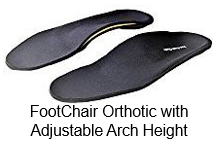 foot. We usually recommend the FootChair Medical Grade Orthotic with adjustable arch height to our patients with iliotibial band syndrome.
FootChair is unique in that it has a stable arch to start with but also comes with 2 arch pads per side that can be added into a pocket under the cover to increase the arch arch height. This allows you to find the arch height that best decrease ITB pain.
Try this PowerStep arch support for about 3 weeks. If it helps but does not eliminate the problem then that is a good sign that custom orthotics will work even better.
Read here about our other recommended prefabricated orthotics.
Stretching the IT Band
Stretching is a very important aspect of treating ITBS. One of the most effective treatments is the use of a foam roller. The short video below demonstrates how to use it.
Other Treatments for ITBS
- Anti-inflammatory Medications
- Rest
- Training Modifications
- Shoe changes or Referrals
- ITB strap
- Foam Roller
- Prefabricated orthotics
We will work with you to determine the best treatment for your ITBS. Contact us today for an appointment in our Seattle foot and ankle clinic. If you are not in the Seattle area, you can try these ITBS home treatments.
Iliotibial Band Syndrome References
- Orchard JW, Fricker PA, Abud AT, Mason BR. Biomechanics of iliotibial band friction syndrome in runners. Am J Sports Med. 1996 May-Jun;24(3):375-9.
- Fairclough J, Hayashi K. Is iliotibial band syndrome really a friction syndrome? J Sci Med Sport. 2007 Apr;10(2):74-6.
- Fairclough J, Hayashi K. The functional anatomy of the iliotibial band during flexion and extension of the knee: implications for understanding iliotibial band syndrome. J Anat. 2006 Mar;208(3):309-16
