




How Should Orthotics Be Made to Stop Bunion Pain and Protect the Big Toe Joint?
A number of well done studies have demonstrated how orthotics should be made in order to relieve bunion pain and pressure in the big toe joint.
Unfortunately, most patients who come through our Seattle foot and ankle clinic who have had orthotics made for their bunion and big toe problems have orthotics that do not adequately relieve pressure in the joint and thus lead to increased pressure and bunion problems.
Properly made orthotics can help prevent the need for bunion surgery, so be sure to contact us for an appointment as soon as possible if you have bunions or big toe joint pain.
Video: What Orthotic Works Best to Treat Bunions and Big Toe Joint Pain?
How Must Orthotics Be Made to Relieve Bunion and Big Toe Joint Pain?
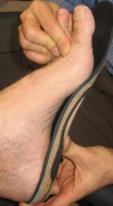
Figure 1 – This orthotic gaps too much from arch to help with bunion pain
A 1996 study by Scherer demonstrated that in order to best relieve bunion and big toe joint pain, an orthotic must act to help the first metatarsal bone angle downward to the floor.
Take a look at the Figures 1 and 2. In figure 1, the first metatarsal bone is at a greater angle to the ground. Scherer’s study and others have shown that orthotics that hold you foot in this position do the best job of decreasing harmful pressure in the big toe joint that leads to bunions, arthritis and pain. Over time this pressure leads to bunions, hallux limitus and hallux rigidus.
The video at the end of this page explains how orthotics work to help treat bunions and other big toe joint problems (the video is made for podiatrists so it may be a bit technical).
Orthotics must conform very tight to the arch of your foot
To prevent these problems, orthotics should be made off a laser image or cast of your foot that is made with your first metatarsal bone pushed down and then the orthotic must conform EXTREMELY TIGHT to the arch of your foot as shown in Figure 2.
By conforming almost airtight to the arch of your foot, the orthotic prevents the ground from pushing up on the first metatarsal bone. These tightly conforming orthotics are called “total contact orthotics”.
Why do Many Orthotics Not Work to Treat Bunions and Big Toe Joint Pain (Hallux Limitus)?
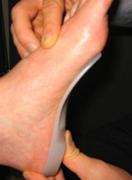
Figure 2 – Tight fitting orthotic helps reduce painful pressure in the big toe joint
Many orthotics do not work well to relieve bunion pain and other big toe problems because they are made with an arch that is too low and doesn’t hug the arch of the foot tight enough. When this occurs the foot is allowed to flatten as it hits the orthotic. This leads to the pressure under the first metatarsal bone, and then increased pressure in the big toe joint as you walk forward. You can see how the orthotic in figure 1 gaps away from the arch of the foot.
The importance of total contact orthotics has been demonstrated in several well done studies. In particular, a study done at George Washington University showed that if you need orthotics to treat big toe joint pain, you want to be absolutely sure that they are made correctly and conform air tight to your arch.
Keys to Making Orthotics for Bunions and Big Toe Joint Pain:
- The cast of your foot that is used to make the orthotics must be a non-weightbearing cast or laser scan. If the foot bears weight while the cast is taken, the resultant orthotic has a flatter arch and is less effective at transferring pressure off of the ball of the foot. Learn more here about how your foot should be casted for orthotics.
- Your doctor MUST place your foot in the correct position when casting.This page discusses proper orthotic casting technique. Casting can be done with plaster or a laser scan. It is imperative that that the podiatrist him/herself takes the cast of your foot. Taking a proper cast is critical and if a medical assistant takes your cast instead of the doctor, you should go to a different podiarist. Proper casting is critical to a good outcome and takes a long time to learn to do properly.
- The podiatrist must write an orthotic prescription that tells the orthotic lab to make the orthotic in a way that the arch of the orthotic is nearly airtight to the arch of the foot. If your doctor’s prescription does not say this specifically, the orthotic will likely gap from the foot and not do a good job at transferring pressure off of the ball off of the balls of your feet.
- The doctor must use a very high quality orthotic lab. There is a lot of variability in the quality of orthotics. Many orthotics are made with arches that are too low in order to prevent any possibility of the patient complaining about the orthotic irritating their arch. Arch irritation does sometimes occur with total contact orthotics, but a good podiatrist will be able to easily adjust the orthotics. If they can’t, you need a podiatrist who has more expertise in orthotic therapy.
What are the Best Prefabricated Arch Supports for Bunions?
Not everyone with a bunion requires a custom orthotic for pain relief. In fact, we often recommend starting treatment with over-the-counter arch supports. OTC arch supports do not, however, conform as close to your arch as well-made custom orthotics so they will not transfer as much pressure off of the balls of the feet.
Like custom orthotics, prefabricated ones work best for big toe joint problems if they have a higher arch. The products below are the ones we recommend to our patients and they are also affiliate links so we may receive a small commission at no additional cost to you if your order from the link.
We list the best prefabricated orthotics and other home treatments for bunions and great toe joint pain here.
Our favorite OTC arch support for bunions and big toe joint pain is the FootChair Medical Grade Orthotic. It has a relatively high 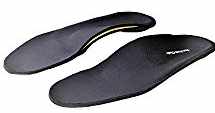 and firm arch plus it includes pads that can be used to further increase the arch height. This increased arch height decreases force on the big toe joint and does the best job of any prefabricated orthotic at reducing force that damages the big toe joint.
For smaller shoes including high heels, flats and soccer cleats, the recommended OTC arch support is 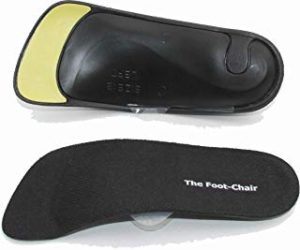 the FootChair Slim Orthotic with adjustable arch support. It’s the most effective OTC arch support we have found to fit in women’s heels and flats. It has the same exceptional adjustable arch support as the full-size FootChair but with a much slimmer profile. In addition it flexes to adapt to most heel heights.
Why Are So Many Bunion Orthotics Not Made Correctly?
Sadly, orthotic therapy is not as well regulated as it should be. Many doctors who provide orthotics are as well trained as they should be in orthotic therapy. In addition, many have not kept up with the latest research on orthotic therapy.
If you have pain under the balls of your feet and would like to have an evaluation, make an appointment to see us in our Seattle foot and ankle clinic. If you already have orthotics, bring them with you so we can evaluate them.
Medical References on Orthotics for Bunions
- Boffeli TJ, Bean JK, Natwick JR. Biomechanical abnormalities and ulcers of the great toe in patients with diabetes. Foot Ankle Surg, 41(6):359-64, 2002.
- Drago JJ, Oloff L, Jacobs AM. A comprehensive review of hallux limitus. J Foot Surg 23: 213, 1984.
- Ebisui JM. The first ray axis and the first metatarsophalangeal joint; an anatomical and pathomechanical study. J Am Pod Med Assoc, 58:160-168, 1968.
- Grady JF, Axe TM, Zager EJ, et al. A retrospective analysis of 772 patients with hallux limitus. J Am Podiatr Med Assoc 92:102, 2002.
- Hetherington VJ, Johnson RE, Albritton JS. Necessary dorsiflexion of the first metatarsophalangeal joint during gait. J Foot Surg 29: 218, 1990.
- Kashuk KB. Hallux rigidus, hallux limitus and other functionally limiting disorders of the great toe joint: background, treatment and case studies. J Foot Surg 14: 45, 1975.
- Kelso SF, Richie DH Jr, Cohen IR, et al. Direction and range of motion of the first ray. J Am Podiatr Med Assoc, 72:600-605, 1982.
- Laird PO. Functional hallux limitus. Illinois Podiatrists 9:4,1972.
- Roukis TS, Landsman, AS. Hypermobility of the first ray: a critical review of the literature. J Foot Ankle Surg, 42: Nov/Dec 2003.
- Roukis TS, Scherer PR, Anderson CF. Position of the first ray and motion of the first metatarsophalangeal joint. J Am Podiatr Med Assoc 86:538-546, 1996.
- Scherer PR, Sanders J, Eldredge D, et al. Effect of functional foot orthoses on first metatarsophalangeal joint dorsiflexion in stance and gait, J Am Podiatr Med Assoc 96(6):474, 2006.
- Shereff MJ. Pathology, anatomy and biomechanics of hallux valgus. Orthopaedics 13: 939, 1990.
- Whitaker JM, Augustus K, Ishii S. Affect of low dye strap on pronation sensitive mechanical attributes of the foot. J Am Podiatr Med Assoc. 93:118, 2003.
